OE Logo
Blog|1 January 2021

Digital Supply Chain: Animated Presentation

Digital Supply Chain: Animated Presentation

The following video, part of the “Surviving and Thriving” supply chain study produced in partnership with SAP, shows how supply chain leaders effectively prioritize their value chains to minimize risk and maximize opportunities. These leaders have visibility into of their organizations’ value chain, ensuring that decisions can be made quickly and accurately, especially in times of crisis such as the world faced in early 2020.


Read more

Blog|27 December 2020

The Work Ahead: Digital First (to Last)

The Work Ahead: Digital First (to Last)

Cognizant’s Center for the Future of Work partnered with us to survey 4,000 C-level executives and find out how they are planning on leveraging their digital capabilities in the coming year.

In this video, our research is showcased to discuss the “digital first” trend that has been intensified by the coronavirus pandemic. By using AI, automation and analytics, businesses can find solutions to the changing business landscape.

Read more

Blog|18 December 2020

Looking ahead to 2021: Behavioural shifts drive transformation

Stephen Foreman
Stephen Foreman
Associate Director, Economic Footprint & Sustainability
Looking ahead to 2021: Behavioural shifts drive transformation

graph 2

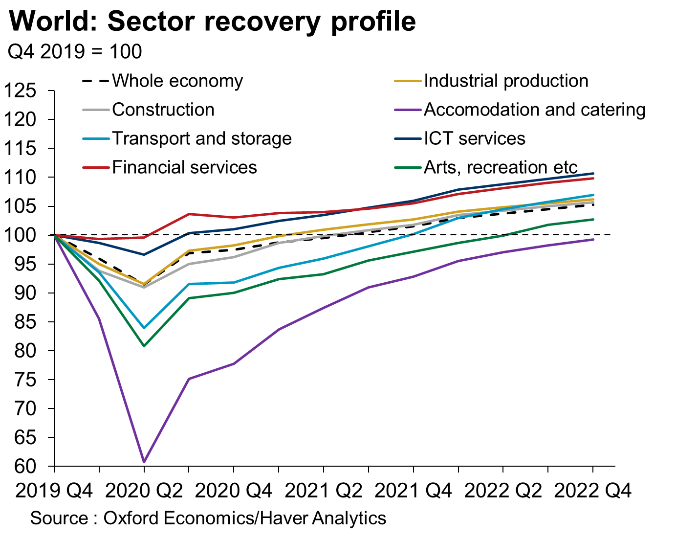
Responding to my colleague Ben May’s recent piece on the key macro themes driving the 2021 economic outlook, this blog looks at the key sectoral themes for the post-covid world. Overall, we believe the pandemic will have a lasting impact on the behaviour of individuals and firms’ business models. Some shifts will leave permanent damage on sectors, whilst others will open up opportunities in 2021.

Read more

Blog|15 December 2020

Looking ahead to 2021: The rollercoaster ride continues

Ben May
Ben May
Director, Macro Forecasting & Analysis
Looking ahead to 2021: The rollercoaster ride continues

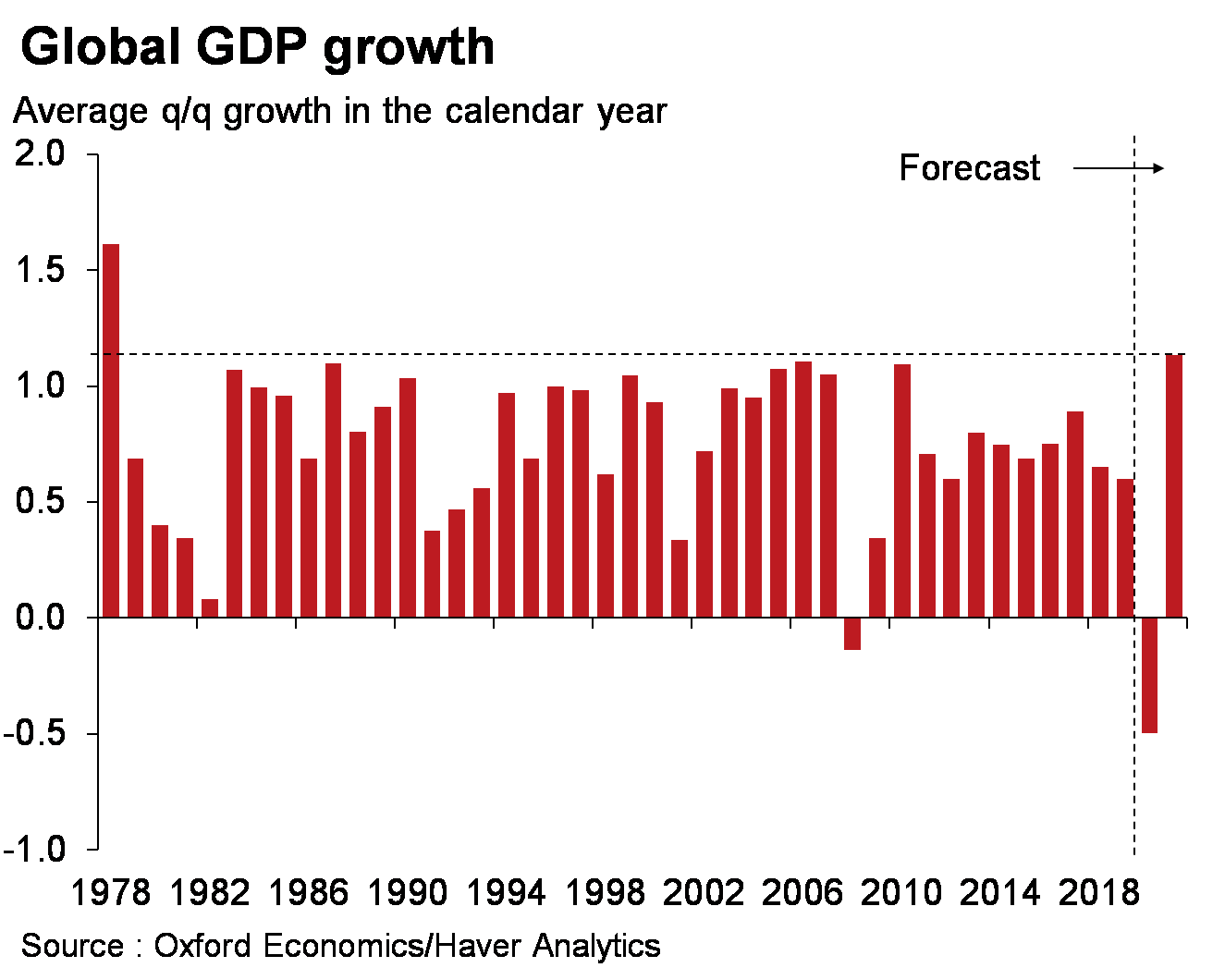
graph12Predictions of record-breaking growth next year point to huge opportunities after a truly dismal 2020. But while 2021 may well be the best year for the global economy in more than 40 years – we expect global GDP to grow by 5.1% – it won’t seem like boom times, and plenty of challenges remain for both firms and policy-makers. We expect economic developments and the relative winners and losers in 2021 to be dominated by three key themes:

Read more

Ungated Post|10 December 2020

Australian Securitisation Forum | Chief Economist Panel Discussion 2020

Australian Securitisation Forum | Chief Economist Panel Discussion 2020

Sarah Hunter, Chief Australian Economist at BIS Oxford Economics joins Shaun Roache from S&P Ratings on this Australian Securitisation Forum panel discussion!

In the panel discussion, Sarah discusses the global economic outlook for 2021 as well as the expected next steps for domestic fiscal and monetary policy. The panel explores further talking points which include geopolitics, populism and socially perceived epidemiology.

Read more

Blog|10 December 2020

Will your digital investment strategy go from virtual to reality?

Will your digital investment strategy go from virtual to reality?

Oxford Economics and EY surveyed 1,001 executives with technology decision-making responsibility across industries worldwide about their digital strategies and results. This report highlights six key actions to help improve your digital strategy and realize a return on digital investments. Key findings include:

  • Digital leaders have clearer strategies and better technical execution, resulting in higher return on digital investment and revenue growth.
  • Internet of Things (IoT), cloud and AI become table stakes as digital spend accelerates, but most companies have yet to realize full technology benefits.
  • CXOs have differing preferences on organic vs. inorganic digital investment strategies. Digital M&A is more likely to exceed expectations.

Read more

Oxford Economics and the Society for Human Resource Management (SHRM) partnered with SAP SuccessFactors to understand the emerging realities facing employers and employees—and next steps for leaders in 2021 and beyond.

New research from Oxford Economics and IBM shows data strategies, AI, and cloud are increasingly effective and intertwined.

Ungated Post|1 December 2020

London Stock Exchange Group’s 1000 Companies to Inspire Britain

London Stock Exchange Group’s 1000 Companies to Inspire Britain

Twitter_CTIB2020_Book2Oxford Economics is proud to announce that it has been identified as one of London Stock Exchange Group’s ‘1000 Companies to Inspire Britain’ 2020. 

Read more

Blog|20 November 2020

Getting the most out of the gig economy

Getting the most out of the gig economy

The use of contingent workers has been growing and is likely to remain high, driven in part by the impact of COVID-19. An increasingly competitive business landscape demands new ways of acquiring, diversifying, and retaining top talent—all of which are expected to become more critical in the wake of the pandemic.

Read more

In this study, commissioned by the Computer and Communications Industry Association, we explore the economic and social impact of digital services in Europe, and identify the actions digital services providers are taking to tackle illegal and harmful content.

In 2019, Huawei supported a £3.3 billion contribution to UK GDP. The company also had a sizeable impact on the UK labour market. We estimate the company supported 51,000 jobs in the UK in 2019. Huawei is estimated to have supported £1.1 billion in tax receipts for HM Exchequer in 2019. This would be sufficient to fund the annual salaries of 30,400 teachers in UK schools.

This report in partnership with IBM explores the growing role of the Salesforce software in leading companies across the world.

The European music sector has a major impact on the economies of the EU and the UK. In 2018 the recorded music industry supported an €81.9 billion contribution to EU27 and UK GDP, according to a study by Oxford Economics, commissioned by IFPI. This was larger than the GDP of nine of the 28 EU Member States in that year. Of this contribution, €37.5 billion was generated by the music sector itself through its output, wages and tax payments. To give a sense of scale, this was 1.5 times larger than that made by the wine-making and brewing sectors.

Ungated Post|12 November 2020

Gregory Daco: The Economic Outlook Under President Biden

Gregory Daco: The Economic Outlook Under President Biden

Gregory Daco, Chief US Economist at Oxford Economics outlines the economic outlook under President-elect Biden. 

Read more

In this study, commissioned by Huawei, we explore how it contributes to economies across Europe through its operations and international supply chains.

A lady using her laptop
Blog|1 November 2020

Managing for the way we work now

Managing for the way we work now

Many American workers, both in traditional roles (e.g., W2 employees) and the extended workforce (e.g., non-payroll workers such as freelancers, independent contractors, and contingent workers), have seen vast changes driven by the COVID-19 pandemic. Suddenly, ways of working long familiar to contingent workers—remote, gig, and flexible work—have become commonplace.

Read more

Ungated Post|30 October 2020

Chart of the week: The impact of Biden win on the economy

Innes McFee
Innes McFee
CEO
Chart of the week: The impact of Biden win on the economy

Despite slowing US economic momentum, a worsening health situation, and recent election uncertainty, the policy outlook carries upside risks for the economy. As the democrats have been called winners of the election, we find Bidenomics could lift real GDP growth by 1.2ppts to 4.9% in 2021, vs. 3.7% in a status quo policy baseline.

Read more

The Hidden $20.3 billion: The Cost of Disconnected Payments. Download the new report to discover how payments can act as a source of value and innovation, featuring strategic insights from payment leaders at Microsoft, Uber and Deliveroo.

Oxford Economics and NTT DATA surveyed 1,000 executives and non-executive employees across industry sectors to understand progress toward AI implementation. Even before the pandemic put pressure on companies to accelerate their adoption of AI and automation, this shift was in progress.