
Overview
The economic consequences of climate change do not fall evenly. A coastal logistics hub faces fundamentally different risks from an inland manufacturing region. A city built on carbon-intensive industries faces a far different transition than one driven by services.
Understanding these local nuances is critical for decisions on where to invest, lend, or operate.
Our City Climate Scenarios service applies climate scenario analysis to cities and regions across Europe, the US, and Canada. We deliver detailed forecasts for nearly 3,000 locations, giving you the granularity to make data-driven, locally informed decisions.
What’s included
By combining global climate scenarios with city-level economic modelling, our service enables you to quantify and compare how different climate and policy pathways could shape local economies.

City climate scenarios
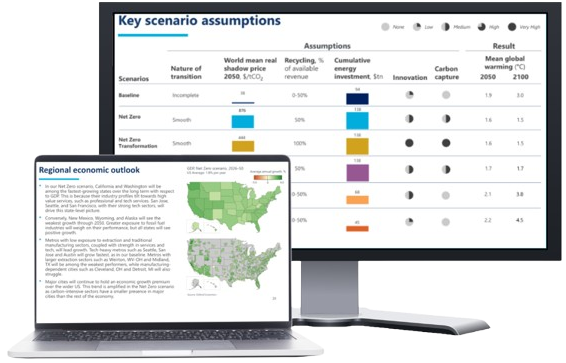
Climate scenario forecasts to 2050 for nearly 3,000 cities and regions, including NGFS-linked and Oxford Economics’ proprietary scenarios. Results reflect both physical and transition risks, with quarterly updates.

City baseline forecasts
The service includes our baseline forecasts for cities and regions, covering a wide range of economic, labour market, and consumer indicators.

City climate chartbook
Regional chartbooks for the US, Canada, and Europe, summarising scenario assumptions and their subnational implications.

Research Briefings
Thematic research exploring key climate-related topics, from energy transition and flooding risks to climate policy developments.

Expert support
Direct access to our city and climate specialists for questions regarding our scenarios and forecasts, supplemented by regular webinars.

Coverage
- UK and Europe: all NUTS 1, NUTS 2 and NUTS 3 regions across major countries, and local authority districts in the UK (totalling almost 2,400 locations).
- United States: all states, metropolitan statistical areas, and metropolitan divisions.
- Canada: all provinces and census metropolitan areas.
Benefits
- Make data-driven, risk-informed investment, lending, and planning decisions based on how different physical and transition pathways affect local economies and markets.
- Quantify local economic impacts. Assess how climate pathways shape growth, employment, income, and demand across cities and regions.
- Support climate risk assessment and reporting. Use robust, location-specific analysis to support risk assessment, regulatory requirements, and strategic decision-making.
- Evaluate hyperlocal disruption from climate risks. Through our consulting services, we extend this analysis to a hyperlocal level, combining climate scenarios with geospatial modelling to assess the economic impact of climate events, such as flooding, on economic activity in vulnerable areas. Click here to contact our team.
Why Oxford Economics?
Best-in-class climate and economic modelling combined
Our climate scenarios are underpinned by the Global Economic Model, linking the economy, the energy system, and the environment. Combined with our deep understanding of local economies, including sectoral structure, inter-regional linkages, and vulnerability to extreme climate events, this enables us to quantify how climate pathways affect cities and regions.
Consistent and comparable framework
The climate scenarios are produced within a consistent modelling framework, ensuring true like-for-like comparison across locations.
Transparent and auditable approach
All our climate assumptions, transmission channels and outputs are clearly documented, supporting internal validation, regulatory use, and stakeholder reporting.
Request a free trial
Complete the form and we will contact you to set up your free trial.
Latest insights






Request a free trial
Complete the form and we will contact you to set up your free trial. Please note that trials are only available for qualified users.
We are committed to protecting your right to privacy and ensuring the privacy and security of your personal information. We will not share your personal information with other individuals or organisations without your permission.
