

Australian Construction Services
Construction forecasts and project intelligence for strategic planning, business development, and competitive advantage.
Overview
Integrated forecasts and project intelligence for Australia’s building and engineering construction markets
Australia’s construction market is undergoing a transformational change. Residential pipelines are shifting under affordability pressures, migration trends, and evolving housing policy. Non-residential building is being redefined by changing workplace patterns and demographic demand. Engineering construction is being reshaped by the energy transition, resource investment, and major government programmes.
For businesses operating in this market, the challenge is understanding not just the headline picture, but where activity is concentrating, which projects are coming, and how to position ahead of the next shift. Oxford Economics Australia’s Construction Intelligence Services deliver rigorous long-run forecasts grounded in economic modelling, alongside timely, granular project pipeline intelligence, helping you anticipate change and act with confidence.
Why Oxford Economics?
Australia’s construction market calls for intelligence that is both analytically rigorous and practically grounded. Oxford Economics Australia brings together decades of forecasting experience with deep local knowledge and globally consistent standards.

15-year forecasts
Long-run building and engineering construction forecasts across all states and 90+ sectors.

Live project intelligence
Building and engineering project databases with real-time status, participant data, and geographic mapping.

Competitor intelligence
Market Mapper tools to benchmark your market position and identify where to differentiate.

Expert-authored analysis
Independent quarterly reports, research briefings, and in-house briefings from Australia’s leading construction economists.

Independent analysis
Unbiased, data-driven insight, independent of construction activity, investment decisions, and commercial interests.

Model-backed forecasts
Building and engineering forecasts underpinned by a macroeconomic framework internally consistent across sectors and states, and aligned with global economic conditions.

Experienced, available team
Our construction economists bring decades of experience and are available for direct support, in-house briefings, and bespoke consulting.
How it helps?
Our four services are designed to work individually or together. The macroeconomic forecast context directly informs how you read the project pipeline, and the project pipeline gives you the ground-level evidence to validate and apply the forecasts.
Strategic planning and budgeting
Long-run forecasts provide the economic foundation for revenue planning, workforce sizing, and capital allocation across your business.
Resource and supply chain planning
Sector and state-level forecasts across 90+ subsectors let you anticipate demand for labour, materials, and equipment ahead of the market.
Business development and bid strategy
Live project databases give visibility of upcoming projects, participant data, and competitor activity so that your BD efforts land in the right place.
Competitor intelligence and benchmarking
Competitor Market Mapper tools and project participant data help you understand the competitive landscape and identify where to differentiate.
Anticipate market shifts
Stay ahead of turning points in building approvals, infrastructure investment cycles, and project pipeline dynamics with regularly updated independent insights.
Future-proof your strategy
Leverage model-backed, long-horizon forecasts to plan investment, hiring, and market development with confidence as conditions and policy settings evolve.
Our services
Long-run forecasts for building construction
Monthly near-term commentary, quarterly state and territory outlooks, and bi-annual medium-term assessments covering residential and non-residential markets, anchored in Oxford Economics Australia’s macroeconomic modelling framework.
- 15-year horizon
- Monthly near-term commentary
- Quarterly state outlooks
- Bi-annual medium-term assessment
- 15+ non-residential subsectors
- All states and territories
- Excel, Tableau, and Power BI
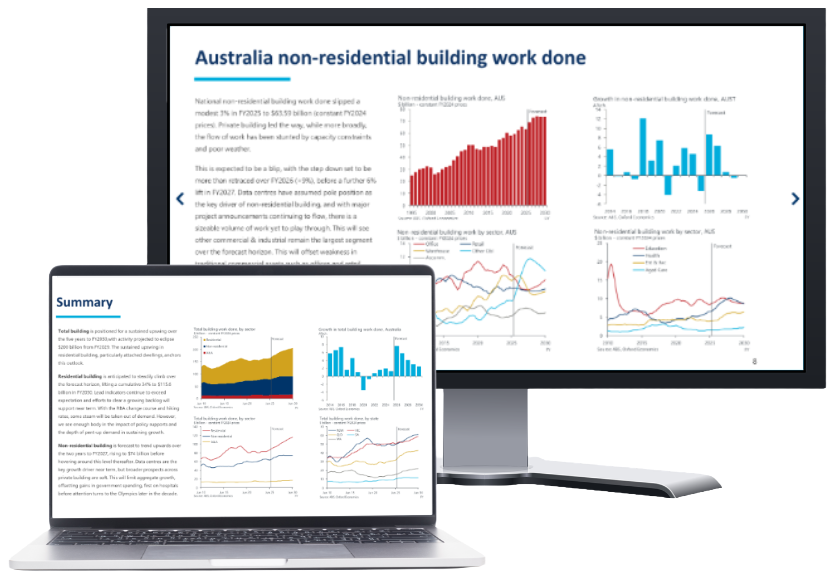
- Residential forecasts: Houses, medium and high-density dwellings, and home renovation markets across all states and territories.
- Non-residential forecasts: 15+ subsectors, including offices, education, health, transport, and retail, updated quarterly to reflect the latest policy changes and economic conditions.
- Emerging asset classes: Forecasts going beyond Bureau of Statistics categories to cover data centres, student accommodation, wind farms, and other high-growth sectors.
- Quarterly updates: Regularly updated to incorporate the latest economic data, policy changes, and project developments.
- Data integration: Excel plug-in and integration with Tableau and Power BI, connecting forecasts directly into your existing technology stack.
Long-run forecasts for engineering construction
Quarterly forecasts across more than 50 engineering subsectors with project-driven work-done estimates, linked to the macroeconomic and demographic fundamentals that drive structural demand for infrastructure.
- 50+ engineering subsectors
- 15-year horizon
- Quarterly project-driven estimates
- Energy transition coverage
- Mining and heavy industry
- Quarterly updates
- All states and territories
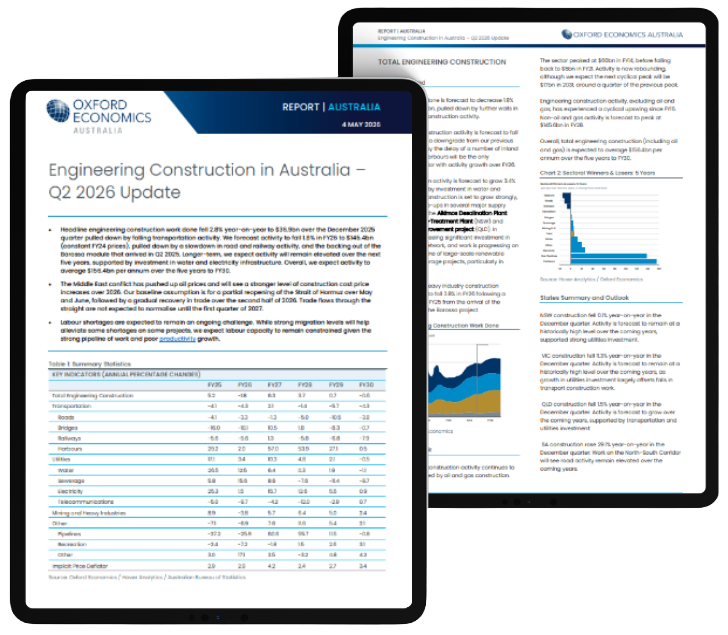
- Subsector coverage: Roads, bridges, railways, harbours, water, sewerage, electricity, telecommunications, recreation, pipelines, mining, and heavy industry.
- Project-driven estimates: Quarterly and annual work-done estimates informed by actual project pipeline data, ensuring forecasts reflect real market dynamics.
- Energy transition coverage: Dedicated forecasts for renewable energy infrastructure, including wind farms, solar, and grid investment.
- 15-year horizon: Long-run visibility for strategic planning, capital allocation, and workforce sizing decisions.
- Quarterly updates: Updated each quarter to reflect the latest economic data, government programmes, and major project announcements.
Live building project database and competitor intelligence
Building Masterplan gives you granular, real-time visibility of the building project pipeline, with detailed participant intelligence and competitor mapping tools that macroeconomic forecasts alone cannot provide.
- Projects over $30 million
- Residential and non-residential
- Developer and contractor data
- Competitor Market Mappers
- Project status tracking
- Geographic heatmaps
- Quarterly database refresh
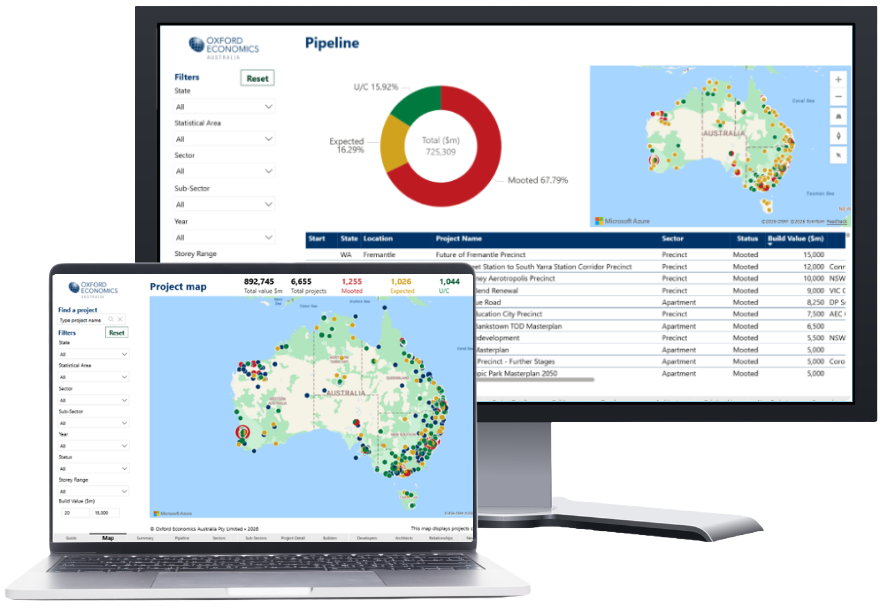
- Building projects database: Detailed listings for all building projects valued over $30 million across residential and non-residential sectors, including value, status, timing, and key participant data.
- Participant intelligence: Detailed information on developers, contractors, and architects across projects, enabling targeted business development and supply chain planning.
- Competitor Market Mappers: Dedicated tools enabling businesses to map competitor project involvement, understand market positioning, and identify differentiation opportunities.
- Project status tracking: Monitor projects from planning and approvals through to construction and completion to manage BD pipelines more effectively.
- Geographic mapping: Customisable visualisations identifying activity hotspots and regional concentration trends, supporting targeted market development decisions.
Live engineering project database and pipeline intelligence
Engineering Masterplan provides full visibility of the infrastructure and heavy industry project pipeline, from planning stage through to completion, with mooted projects included for early stage market intelligence.
- Full infrastructure pipeline
- Mooted projects included
- All scales and asset types
- Project status monitoring
- Geographic heatmaps
- Quarterly database refresh
- Integrated with forecasts
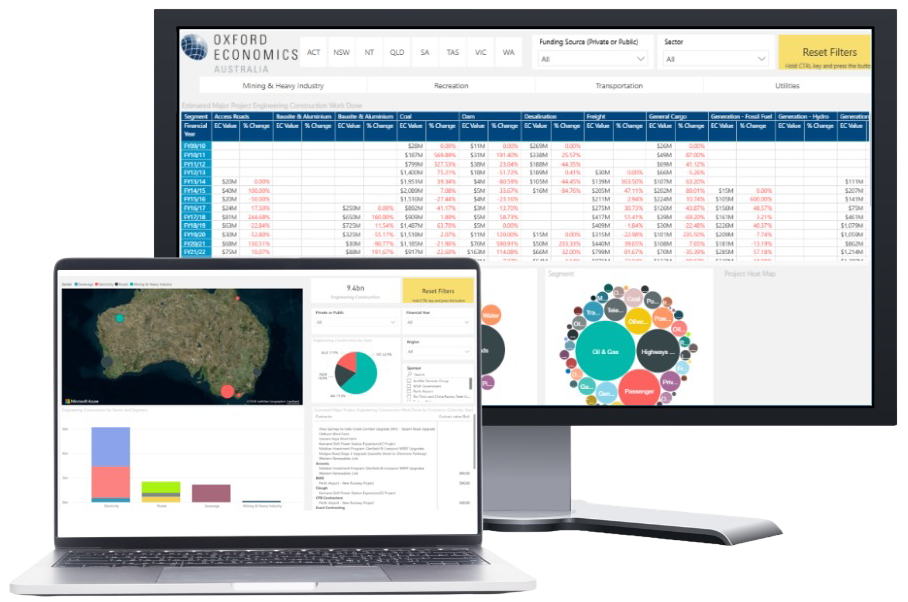
- Engineering projects database: Comprehensive coverage of engineering construction projects across Australia at varying scales, providing a full view of the infrastructure and heavy industry pipeline.
- Mooted projects: Comprehensive listing of announced projects not yet included in forecasts, such as renewable generation assets proposed without adequate grid connections, providing early stage pipeline visibility.
- Project status tracking: Monitor projects from planning through to completion, anticipating future demand and identifying collaboration opportunities.
- Geographic mapping: Customisable geographic visualisations identifying infrastructure activity hotspots and regional concentration trends.
- Quarterly updates: Databases refreshed quarterly, ensuring that project status and pipeline changes are captured and fully integrated with our forecasts.
How can we help you?
Our construction intelligence services are used by a wide range of organisations across Australia’s building and engineering sectors.
Here is how we can support your specific decisions:
Contractors and builders
Identify upcoming projects early, understand competitor positioning, and plan workforce and supply chain requirements ahead of the market.
- Which building or infrastructure projects are entering the pipeline in my target markets?
- Which competitors are winning work in my sectors and geographies?
- Where is demand for labour and materials heading over the next three to five years?
- How is construction activity shifting across states, and where should I focus BD effort?
Developers and investors
Assess market conditions, identify locations with strong forward demand, and stress-test development assumptions against independent economic forecasts.
- Which markets and asset classes offer the strongest long-term construction demand?
- How will affordability, population growth, and policy shifts affect residential development pipelines?
- What is the non-residential development pipeline in my target markets?
- How would different economic scenarios affect construction costs and feasibility?
Government and public agencies
Plan infrastructure investment, assess capacity requirements, and evaluate the economic impact of major construction programmes using independent, model-backed forecasts.
- What is the forward capacity of Australia’s building and engineering construction sectors?
- Where are infrastructure investment gaps most acute across states and sectors?
- How will major government programmes interact with private sector pipelines?
- What are the labour and supply chain implications of planned capital programmes? Which building or infrastructure projects are entering the pipeline in my target markets?
Latest insights







Testimonials
Oxford Economics is synonymous with high quality macroeconomic research. A compelling reason for us to subscribe to its Real Estate Economics Service.

The Real Estate Economics Service allows us to link the top-down economic outlook, drivers and risks, with our market-level forecasting and return expectation setting. This allows us to be more strategic about our allocations and how to build & maintain a well-diversified portfolio.

As an active international lender for commercial real estate, the expansion of Oxford Economics’s Real Estate Economics Service to include analysis and forecasting of real estate markets is a real gain and represents an addition to the comprehensive service we have been benefitting from for many years

For Transwestern’s asset services, investment management and development businesses, we depend on economic inputs and editorial content that are rational and insightful to inform our decisions. Oxford Economics delivers.

CMHC’s Stress Testing and ORSA team has started using Oxford Economics for the purpose of Stress-Testing. Our experience has been very positive. The software is sound, intuitive and user friendly. But most of all, it allows the user to understand the links between the variables and for a certain degree of customization. We have also contracted OE to help us design Stress-Test scenarios.
Request a free trial
Complete the form and we will contact you to set up your free trial. Please note that trials are only available for qualified users.
We are committed to protecting your right to privacy and ensuring the privacy and security of your personal information. We will not share your personal information with other individuals or organisations without your permission.