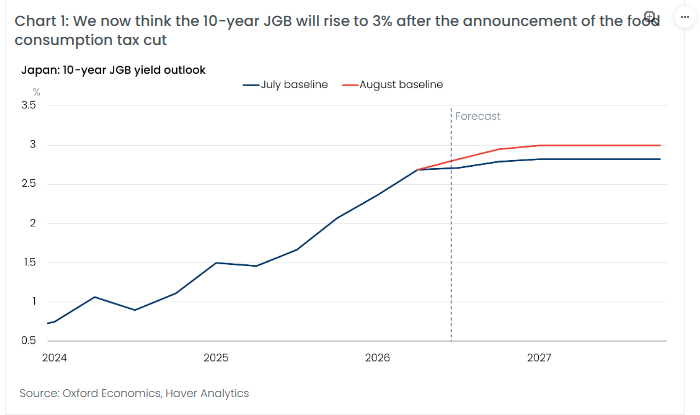

Japan’s consumption tax cut would widen the fiscal deficit and push JGB yields higher
Japan’s Takaichi government approved a plan to cut the food consumption tax to 1% from 8% without resorting to debt finance in FY2027-2028 (Q2 2027-Q1 2029). However, we now assume that a primary balance will deteriorate to a 3% of GDP deficit and the 10-year Japanese government bond yield will rise to 3% by the end of 2026, as it will be challenging to fully make up for the lost tax revenue.
Our modelling suggests that the tax cut will reduce annual tax revenue by around JPY5trn. Although some of the losses will be financed by non-tax revenues and cuts in expenses, we assume that half of the revenue loss will be financed by debt. The primary balance will stay at around a 3% of GDP deficit in 2027-2028, before improving from 2029, when we think the rise in the debt-to-GDP ratio will force the government to take consolidation efforts.
We now think the long-term JGB yield will rise to around 3% by the end of 2026, instead of staying at 2.8%. While the bond market’s reaction to the news has been limited so far, we think the market will start to price in the fiscal effects of the coming tax cut as details of revenue measures become available in the tax policy outline in September and the fiscal year 2027 budget process in December.