OE Logo
Research Briefing | Apr 25, 2022

Broad-based cost pressures needn’t spiral higher
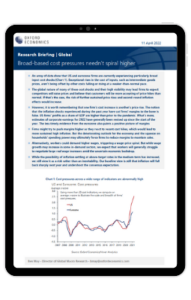
An array of data show that US and eurozone firms are currently experiencing particularly broad input cost shocks. Exceptional rises in the cost of inputs, such as intermediate goods prices, aren’t being offset by other costs falling or rising at a weaker-than-normal pace.


Read more

Research Briefing | Apr 25, 2022

Broad-based cost pressures needn’t spiral higher

An array of data show that US and eurozone firms are currently experiencing particularly broad input cost shocks. Exceptional rises in the cost of inputs, such as intermediate goods prices, aren’t being offset by other costs falling or rising at a weaker-than-normal pace.

Read more

Research Briefing | Apr 25, 2022

Technological decoupling is the real deglobalisation threat

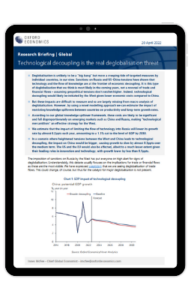
Deglobalisation is unlikely to be a “big bang” but more a creeping tide of targeted measures by individual countries, in our view. Sanctions on Russia and US-China tensions have shown that technology and the flow of knowledge are at the frontier of economic decoupling.

Read more

Research Briefing | Apr 25, 2022

Government debt issuance set to dwarf ECB reinvestments

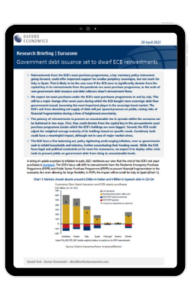
Reinvestments from the ECB’s asset purchase programmes, a key monetary policy instrument going forward, could offer important support for smaller periphery sovereigns, but not much for Italy or Spain.

Read more

Research Briefing | Apr 4, 2022

Norway’s growth outlook impacted by Russia-Ukraine war

The fallout from the Russia-Ukraine conflict and a brief but sharp hit from the Omicron outbreak have prompted us to cut our 2022 mainland GDP growth forecast by 0.7ppts to 3.6%. While government subsidies for household electricity bills are containing energy price rises, the stark strengthening of underlying price pressures has led us to expect the strongest year for inflation since 1989, which is weighing on the consumption outlook.

Read more

Research Briefing | Mar 30, 2022

Market panic in Russia has passed, but recession is looming

Russia’s GDP is unlikely to return to pre-crisis levels until the early 2030s, according to our modelling. We expect Russia’s economy to contract by almost 11% in 2022 and a further 3.3% in 2023, assuming that the war on Ukraine does not continue beyond 2023. Our forecasts also assume that the EU reduces imports of Russian gas this year but does not embargo Russian oil imports.

Read more

Research Briefing | Mar 30, 2022

Market panic in Russia has passed, but recession is looming

Russia’s GDP is unlikely to return to pre-crisis levels until the early 2030s, according to our modelling. We expect Russia’s economy to contract by almost 11% in 2022 and a further 3.3% in 2023, assuming that the war on Ukraine does not continue beyond 2023. Our forecasts also assume that the EU reduces imports of Russian gas this year but does not embargo Russian oil imports.

Read more

Research Briefing

Eurozone inflation to take a toll on consumer spending growth

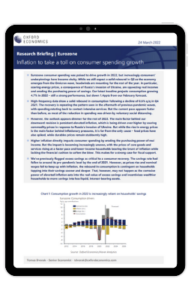
Eurozone consumer spending was poised to drive growth in 2022, but increasingly consumers’ underpinnings have become shaky. While we still expect a solid rebound in Q2 as the economy emerges from the Omicron wave, headwinds are mounting for the rest of the year. In particular, soaring energy prices, a consequence of Russia’s invasion of Ukraine, are squeezing real incomes and eroding the purchasing power of savings.

Read more

Research Briefing

Eurozone inflation to take a toll on consumer spending growth

Eurozone consumer spending was poised to drive growth in 2022, but increasingly consumers’ underpinnings have become shaky. While we still expect a solid rebound in Q2 as the economy emerges from the Omicron wave, headwinds are mounting for the rest of the year. In particular, soaring energy prices, a consequence of Russia’s invasion of Ukraine, are squeezing real incomes and eroding the purchasing power of savings.

Read more

Research Briefing | Mar 22, 2022

War and supply chain shocks dampen global economic outlook

We have downgraded our GDP growth forecasts due to repercussions from Russia’s war on Ukraine and, to a lesser extent, the prospect of further Covid-related supply chain disruption in China. We now expect global GDP growth of 3.4% this year. This is 0.3ppts below our forecast at the start of March and 0.6ppts lower than our February forecast – the last before Russia invaded Ukraine.

Read more

Research Briefing | Mar 22, 2022

Impact of Russia’s invasion of Ukraine will be limited for Sweden

We have lowered Sweden’s growth for this year to 3.1% from 3.6% previously due to the fallout from Russia’s invasion of Ukraine. The main channel will be from higher inflation, weighing on disposable incomes and private consumption. Input shortages, which had been easing until the invasion, are likely to worsen again, although Swedish trade with Russia and Ukraine had been minimal.

Read more

Research Briefing | Mar 22, 2022

Impact of Russia’s invasion of Ukraine will be limited for Sweden

We have lowered Sweden’s growth for this year to 3.1% from 3.6% previously due to the fallout from Russia’s invasion of Ukraine. The main channel will be from higher inflation, weighing on disposable incomes and private consumption. Input shortages, which had been easing until the invasion, are likely to worsen again, although Swedish trade with Russia and Ukraine had been minimal.

Read more

Research Briefing | Mar 18, 2022

Global chip shortage has peaked, but tight supply will endure

The global semiconductor shortage has passed its peak, as chipmakers have ramped up production significantly since the middle of 2021. Chipmakers have increased both production capacity and utilisation to meet the excess demand.

Read more

The GCC countries have entered a period of higher interest rates – their US$ currency pegs mean regional central banks mirror US Fed hikes. Our analysis reveals this might be a modest headwind for Bahrain, Oman and also Qatar, although Saudi Arabia will be cushioned by strong domestic deposit base to finance credit, low external debt and large FX reserves.

Russia’s invasion of Ukraine is being felt throughout the global economy, but few places are as exposed to its impact as the Central and Eastern European (CEE) countries. In addition to surging energy prices, CEE economies will be hurt by renewed supply shortages in manufacturing, loss of access to Russian markets, currency depreciation, and the refugee crisis. 

From a climate change perspective, 2021 was another remarkable year. While not the warmest year on record, a host of extreme weather events and disasters – including extensive flooding in Germany, the Pacific Northwest, India, and China, as well as tornadoes in the American Midwest and Hurricane Ida striking the US South – impacted the global economy.

Russia’s invasion of Ukraine and the evolving global response will be felt in the MENA economies mainly via the impact on commodity prices. Fuel exporters are near-term beneficiaries of oil around $110pb, which lifts export and budget revenues, but we estimate the higher price leads to a 0.1-0.4pp hit to GDP growth in regional energy importers this year.

Following Russia’s attack on Ukraine, the EU Commission has accelerated plans to phaseout Russian gas, with a two-thirds cut this year. To offset the cut, it aims to boost LNG imports and renewables. But we think the EU faces difficult trade-offs in juggling its goal to phase out Russian gas while avoiding economic damage and staying on course to fulfil its green ambitions.

Despite the economic headwinds and much increased uncertainty stemming from the Russian invasion of Ukraine the ECB decided to accelerate its QE exit and keep the door wide open to an interest rate hike later this year. This was a more hawkish outcome than we had expected, but we remain of the view that the council won’t actually hike this year.

The National Bank of Poland (NBP) hiked its policy rate by 75bps at yesterday’s meeting, bringing it to 3.5%. Although a continuation of monetary tightening was expected, the hike exceeded both our and consensus expectations of a 50bps move.

Research Briefing | Mar 7, 2022

US supply chain stress is poised to intensify

US supply chain stress tracker brought bad news in February. Inflation took up the baton from transportation and now represents the most stressed aspect of supply chains as input costs rose and firms exercised pricing power. Good news from the transportation front, however, was diminished by greater activity and labour pressures, while inventory tensions subsided slightly.
Read more

Research Briefing | Mar 7, 2022

US supply chain stress is poised to intensify

US supply chain stress tracker brought bad news in February. Inflation took up the baton from transportation and now represents the most stressed aspect of supply chains as input costs rose and firms exercised pricing power. Good news from the transportation front, however, was diminished by greater activity and labour pressures, while inventory tensions subsided slightly.

Read more

Research Briefing | Mar 1, 2022

Russia – CBR’s huge rate hike unlikely to restore financial stability

Following Russia’s invasion of Ukraine, the US and EU announced harsh new sanctions, including banning some Russian banks from SWIFT and freezing the assets of Russia’s central bank.

Read more

Research Briefing | Mar 1, 2022

Russia – CBR’s huge rate hike unlikely to restore financial stability

Following Russia’s invasion of Ukraine, the US and EU announced harsh new sanctions, including banning some Russian banks from SWIFT and freezing the assets of Russia’s central bank.

Read more

Research Briefing | Feb 25, 2022

Turkey’s outlook sours after Russia invades Ukraine

Turkey will take a hit from the Russian invasion of Ukraine through three main channels – tourism, energy prices and financial market disruption – all of which will put further stress on price and financial stability. Altogether, we estimate the impact may shave 0.4ppts from our 2022 growth forecast of 2.5% for Turkey.

Read more

Research Briefing | Feb 25, 2022

Turkey’s outlook sours after Russia invades Ukraine

Turkey will take a hit from the Russian invasion of Ukraine through three main channels – tourism, energy prices and financial market disruption – all of which will put further stress on price and financial stability. Altogether, we estimate the impact may shave 0.4ppts from our 2022 growth forecast of 2.5% for Turkey.

Read more

Research Briefing | Feb 24, 2022

2022 GDP growth forecast for Sweden raised, but high inflation is a key downside risk

We have raised our full year 2022 GDP growth forecast to 3.6% from 3.3% previously, due to the especially strong flash estimate for Q4 2021. The Omicron wave has probably peaked and has been mild overall, with restrictions largely abolished. However, we expect inflation to stay higher for longer, denting real incomes and presenting a downside risk for our consumption outlook.

Read more

Research Briefing | Feb 24, 2022

2022 GDP growth forecast for Sweden raised, but high inflation is a key downside risk

We have raised our full year 2022 GDP growth forecast to 3.6% from 3.3% previously, due to the especially strong flash estimate for Q4 2021. The Omicron wave has probably peaked and has been mild overall, with restrictions largely abolished. However, we expect inflation to stay higher for longer, denting real incomes and presenting a downside risk for our consumption outlook.

Read more