



In this blog, we address the key questions raised on economic growth, AI adoption, trade policy during our Global Economic Outlook Conference in London.
In this blog, we address the key questions raised on economic growth, AI adoption, trade policy during our Global Economic Outlook Conference in London.

Louise Loo, Leas Economist at Oxford Economics, discusses how China’s economy will develop and provides economic forecasts for 2024.

The past few months have been especially challenging for China, but the problems that are apparently not new. Much of China’s current slowdown is structural in nature, but it is happening too quickly for authorities’ comfort.
Louise Loo, Lead Economist at Oxford Economics, discusses China’s credit data, the next steps for the PBOC and the decline in foreign direct investment with Bloomberg Television.

Louise Loo, China Lead Economist at Oxford Economics, joins CNBC to discuss the cautious approach of the Chinese central bank towards monetary policy.

Louise Loo, Lead China economist at Oxford Economics, says “the easing bias is still there, but we’re likely to see different kinds of easing.”

We are unconvinced that recent measures mark a turning point in China’s housing downturn and the resulting banking system is likely to be less profitable, impairing the transmission mechanism of future monetary policy. In this week’s Beyond the Headlines, join Louise Loo, Lead Economist, Macro Forecasting and Analysis, as she discusses if the banking system can rescue the Chinese property sector.

As the Chinese economic recovery accelerates, China Daily speaks with Louise Loo, Lead Economist at Oxford Economics to gauge our confidence in the Chinese economy and their forecast for its operation in 2023 and beyond.

Louise Loo, Lead China Economist at Oxford Economics, discusses China’s decision to not cut rates this weekend.

Louise Loo, Lead Economist at Oxford Economics, discusses China’s economic data and says “the best way to tackle a confidence crisis is to be very quick on your stimulus”.

One of China’s longer term economic challenges has been its ability to transition successfully away from an investment-led growth model towards consumption.
In this week’s Beyond the Headlines, join Louise Loo, Lead Economist, as she examines the different kinds of rebalancing that has been seen in China.
Louise Loo, China Economist at Oxford Economics, speaks with CNBC to discuss the Chinese economy, government and policies.

Despite heightened policy uncertainty global economic activity has remained resilient in 2025 and we expect that to continue in 2026 after a soft start to the year.
We recently upgraded our China growth forecasts on more resilient domestic demand conditions, compared to our prior expectations. This does not mean China is out of the woods yet – private investments, though not as bad as feared, remain tepid by historical standards, and consumption remains lacklustre despite more aggressive stimulus. Disinflationary pressures are also more pervasive than previously appreciated. We update our macro views on China and the spill overs that could have on the rest of the region.
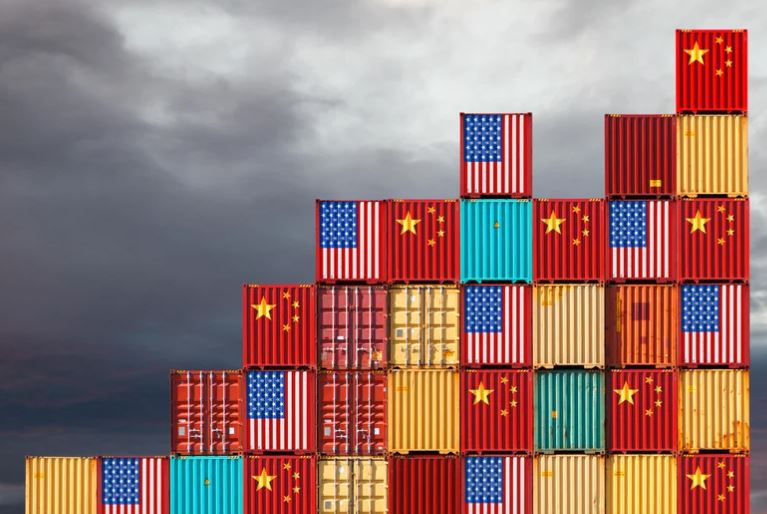
Powered by insights from our TradePrism forecasting platform, this webinar will explore recent developments, changes to the near- and long-term trade outlook and how businesses can navigate the increasingly fragmented world.
Trade wars are costly for everyone, but there are clear relative losers and winners. Tariffs will cripple US-China trade, and we expect China’s goods trade surplus to shrink but only to a still substantial 3.2% of GDP this year and remain significant in the medium term owing to trade diversification, shifts up the export value chain, and the reduced import intensity of Chinese demand. Ironically, other than China, the relative winners list includes the very countries Trump targeted most heavily in his April 2 tariff regime: Vietnam, Cambodia, Malaysia, Pakistan, and the Philippines

While the direct macro effects of new (and potential) US tariffs could prove manageable for an economy with China’s fiscal resources, Beijing’s policy toolkit in response to rising tariff risks is also much bigger this time around, creating an additional source of uncertainty to the outlook. We dive into the range of possible retaliatory responses from China to ongoing trade tensions, the delicate balancing act between managing strategic interests and domestic economic headwinds, and their implications for our China forecast both in the short and medium terms.

Chinese policymakers have doubled down in recent months in signalling a strong policy response to the economy’s domestic and external economic challenges. But after months of policy disappointments, how aggressive and effective will and can stimulus be? What are officials signalling differently in this year’s Two Sessions, about their assessment of the economy’s twin debt and domestic demand challenges? We explore the implications for growth in China and why foreign spillovers from China’s policy developments this year could look different compared to past cycles.

Oxford Economics set the stage for the year ahead, at our inaugural Global Economic Outlook Conference, in London on Wednesday, 24th January.

We help you understand today’s China, and plan for its tomorrow.