

The top cities in the Asia Pacific in 2026

With Asia Pacific (APAC) hosting some of the world’s largest and most advanced city economies, as well as some of its fastest growing, the region’s challenge to the dominance of Europe and North America in the global economy continues to intensify. This economic strength of APAC’s major cities, augmented by impressive standings across Human Capital and Quality of Life metrics, is demonstrated by their high and rising rankings in our latest Global Cities Index for 2026.
APAC’s most advanced cities hold their ground at the highest ranks of the Global Cities Index
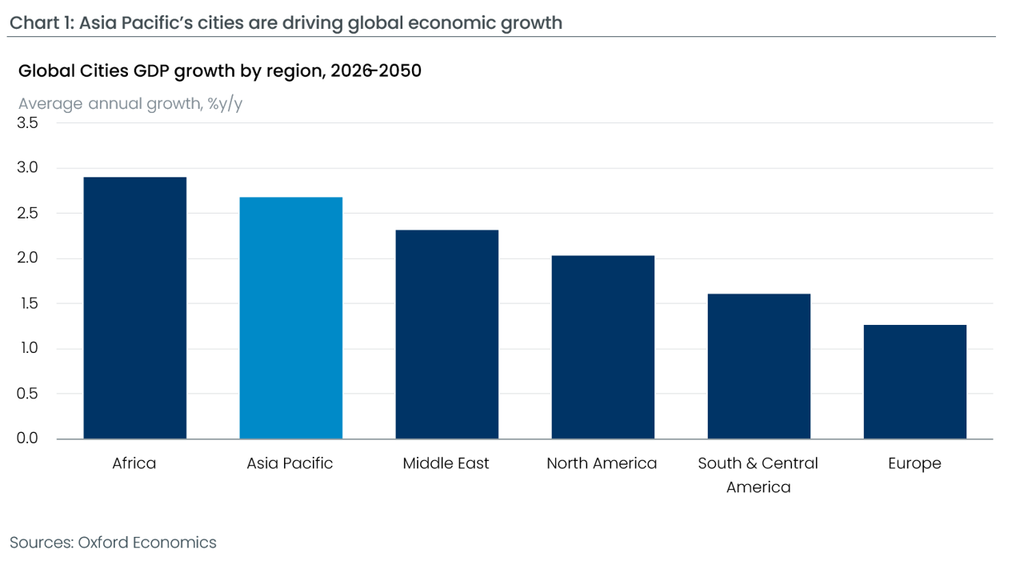
Asia Pacific’s (APAC) major cities are continuing to drive the pace of global economic growth and are increasingly shifting the world’s economic centre of gravity eastward. Over the next 25 years, we forecast real GDP growth across 396 cities in Asia Pacific to average 2.7% per year, faster than the city averages of any other region outside of Africa. By 2050, APAC’s cities will account for 40% of the GDP produced by the world’s 1,000 largest cities, up from 35% today and just 23% in 2001.
With the region hosting some of the world’s biggest, most advanced, and most established city economies, as well as some of its most dynamic and fastest growing, Asia Pacific hosts a breadth of opportunity and is increasingly challenging the dominance of Europe and North America. The economic strength of APAC’s major cities, augmented by their impressive standings across Human Capital and Quality of Life metrics, is demonstrated by their high and rising ranks in our 2026 Global Cities Index.
The pinnacle of Asia Pacific’s economic strength today is exemplified by the region’s most mature and advanced cities, which maintain their standings in the top reaches of our index. Principal among them is Tokyo, the world’s second-largest city economy and second-most populous, placing ninth globally in the overall index. While the Japanese capital generally experiences slower economic growth than elsewhere in the world, and is no doubt exposed to the challenges of the Far East’s ageing populations, its sheer size and economic might combined with its reputation as a premier location for corporate headquarters, world-class universities, and astounding cultural assets mean it remains a vibrant city of enormous international importance.
Demonstrating their remarkable record across all categories of the Global Cities Index, from Economics and the Environment to Quality of Life and Governance, five of Australia’s state capitals also feature in the top 50 of our index. Sydney leads the pack in 13th place, just ahead of Melbourne in 16th, and Brisbane and Perth in 36th and 44th, respectively. Meanwhile, the national capital Canberra in 45th place can also boast taking the top spot among the 1,000 Global Cities for the Quality of Life metric, with its residents enjoying some of the highest and relatively equally distributed incomes, lowest crime rates, and longest life spans globally.
Rounding out Asia Pacific’s highest-ranking cities are Singapore (29th), Seoul (38th), and Taipei (48th), with the latter a new addition to the top 50 this year. These cities arguably characterise the heart of Asia Pacific’s dominant semiconductor industry, with the AI-related surge in demand for advanced chips supercharging their economies recently. While these cities also represent some of Advanced Asia’s most acutely ageing populations, the size of their economies, their strengths across other Human Capital and Quality of Life metrics, and their position at the centre of a world-changing technology means they rightly stand among the world’s most important cities.
Emerging APAC’s rapidly growing cities are poised to climb higher
While Advanced Asia’s mature megacities maintain their places at the very top of our global rankings, Emerging cities in the region are poised to join them. A common theme among the most exciting prospects in Emerging Asia is the fast pace of their demographic and economic growth, characterised by a virtuous cycle of sectoral compositions moving up the value chain to higher-productivity, higher-wage activities, which attract, retain, and train high-calibre workers. In our 2026 report, we have highlighted five “Cities to Watch”, including Kuala Lumpur, Shenzhen, Bengaluru, Ho Chi Minh City, and Tashkent, as some of the leading representatives of Emerging Asia’s multitudinous growth opportunities and some of its top candidates for future top spots in our index.
The highest-ranked of these today is Kuala Lumpur, knocking on the door of the top 50 in 65th place. For decades, Southeast Asia’s urban economic landscape has been dominated by Singapore, however, Kuala Lumpur is gaining attention as a fast-growing, dynamic city with global relevance, leveraging its deep pool of human capital, relatively lower operating costs, and expanding finance and technology sectors to challenge for a top spot. Ho Chi Minh City, Vietnam’s foremost finance, business, and trade hub, at 205th, represents similar qualities to the Malaysian capital, serving as a cost-effective centre for international activity and a gateway into South Asian markets. We notably expect the city to rank among the 50 fastest-growing cities over the next five years.
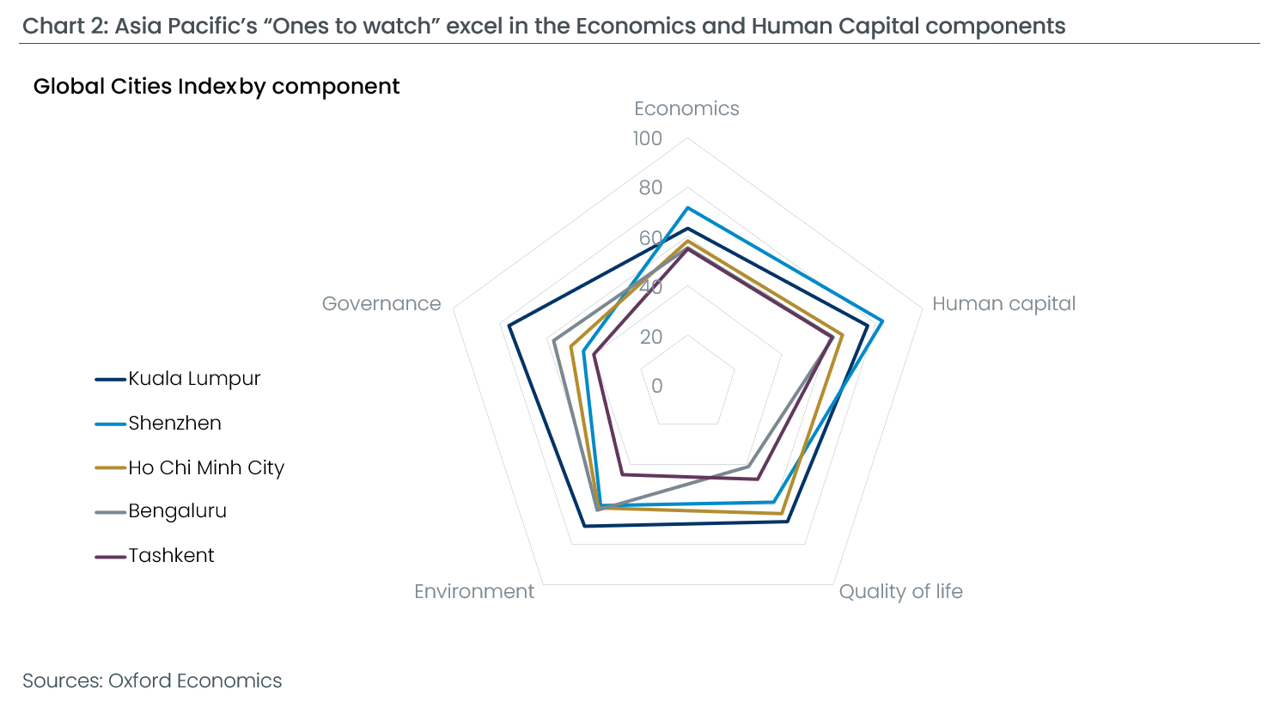
Shenzhen, our pick for mainland China, and arguably the crowning jewel of the country’s economic ascent over the past 50 years, is the country’s highest-ranked city in our index and the first to reach a top 100 spot at 93rd. The city’s rising stature among the world’s most important cities is driven by its economic strength and leading role in creating and commercialising new technologies, from robotics to green innovations. Shenzhen’s strong position is reinforced by its human capital with workers from across China, long drawn to the economic opportunities created within the city, driving its fast population growth. Already the 14th-biggest metropolis in the world, we expect Shenzhen to become the 11th-largest by 2050.
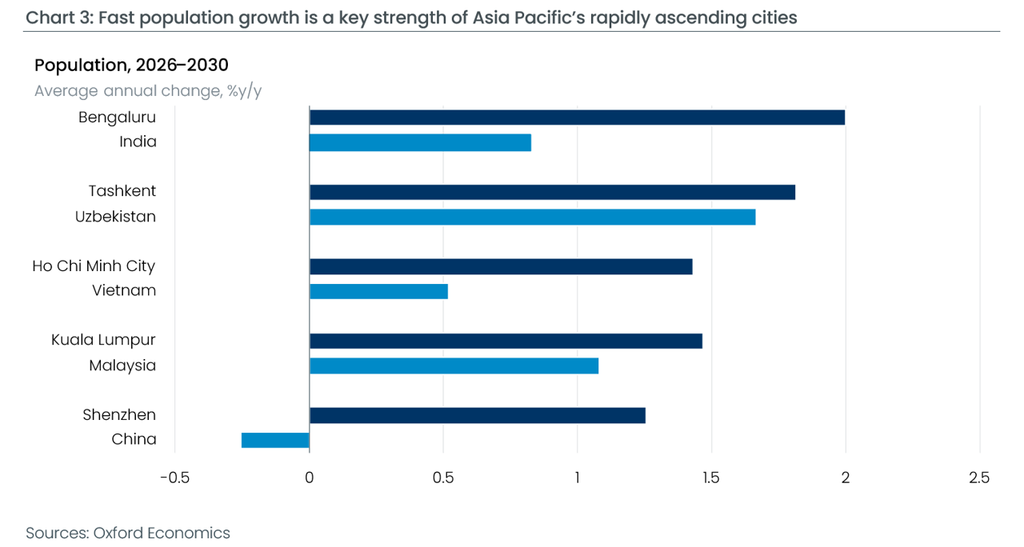
No other country, however, comes close to India for the sheer breadth of urban growth. By 2050, we project Delhi to be the most populous city in the world and expect six of the top 10 fastest-growing cities by real GDP over the next 25 years to be in India. Indeed, Indian cities combine exceptional GDP growth, deep university and corporate networks, and rapidly expanding labour markets to deliver strong economic momentum, even as weaker Quality of Life and Environment scores continue to hold its cities back from the upper echelons. The country’s strengths are exemplified by the southern tech metropolis Bengaluru (311th), which is expected to be among the 10 fastest-growing cities in the world for forecast GDP growth.
The final Asia Pacific City to Watch is the Uzbek capital of Tashkent. The city ranks 343rd in the index and epitomises the ongoing ambitious programme of economic liberalisation and WTO accession in the country. As a hub of Central Asia, Tashkent is rocketing up our rankings: with rapidly expanding construction, finance, and business service sectors, Tashkent ranks in the top 10 for long-term GDP growth and rightly deserves a spotlight, despite being in an often-overlooked region.
Overall, Asia Pacific’s major cities showcase a breadth and depth of opportunity, from the world’s most advanced and established markets to those rising in profile and economic strength. Our Global Cities Index helps business decision makers understand the enormous range of potential investment prospects available as the balance of global economic activity tilts to the east.
Top 10 APAC cities in 2026 Global Cities Index
- Tokyo
- Sydney
- Melbourne
- Singapore
- Brisbane
- Seoul
- Perth
- Canberra
- Taipei
- Auckland
To explore the full rankings and see how other cities perform, visit the 2026 Global Cities Index site.
You might also be interested in
Explore the 2026 Global Cities Index
REQUEST A TRIAL
Access detailed city analysis and forecasts with a free trial of our cities and regions services.