

Research Briefing
| Sep 24, 2024
Asia Pacific: US-China trade tensions may benefit ASEAN
The risk of higher trade tensions, and its subsequent implications on trade policy, is high. The upcoming US presidential election this November has the chance to spark an escalation of a global trade war if former President Donald Trump returns to the White House. However, even without the former president returning, tariff risks to ASEAN economies are rising, particularly through anti-dumping tariffs.
What you will learn:
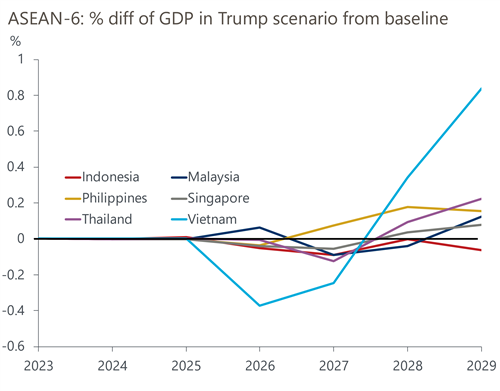
- Higher US-China trade tensions present risks to Southeast Asian (ASEAN) economies. In our “full-blown Trump scenario”, we expect lower real exports and economic growth, and weaker ASEAN currencies against the US dollar. However, trade diversions may help mitigate the initial fallout.
- Higher tariffs on China and elsewhere affect ASEAN in three ways. First, linked value chains mean lower demand for Chinese goods will impact ASEAN exporters supporting Chinese producers. Second, lower global growth will weigh on external demand and third, ASEAN goods that directly compete with Chinese goods as substitutes will become relatively cheaper for US consumers.
- On balance, we think that the effects of trade substitution and trade diversion will outweigh the hit to growth. But this will likely take time.
- We believe a downside risk to growth that wasn’t modelled as an assumption in the scenario is the increasing likelihood of anti-dumping tariffs from the US on ASEAN economies.
- The scenario points to higher inflation in the US relative to the baseline forecast. This likely means a higher policy rate from the US Fed, resulting in a stronger US dollar and in turn, weaker ASEAN currencies.