
Will Greenland be the catalyst for a new trade war?
Rising tariff threats over Greenland heighten risks for global growth and trade stability
The risk of tariffs and policy uncertainty being a larger drag on the global economy early this year increased over the weekend after the US threatened tariffs on six EU countries, the UK, and Norway, as it digs its heels in on acquiring Greenland.
Tensions between the US and Europe could be diffused as soon as today at meetings that are reportedly set to take place in Davos, so it’s too early to change our baseline forecast.
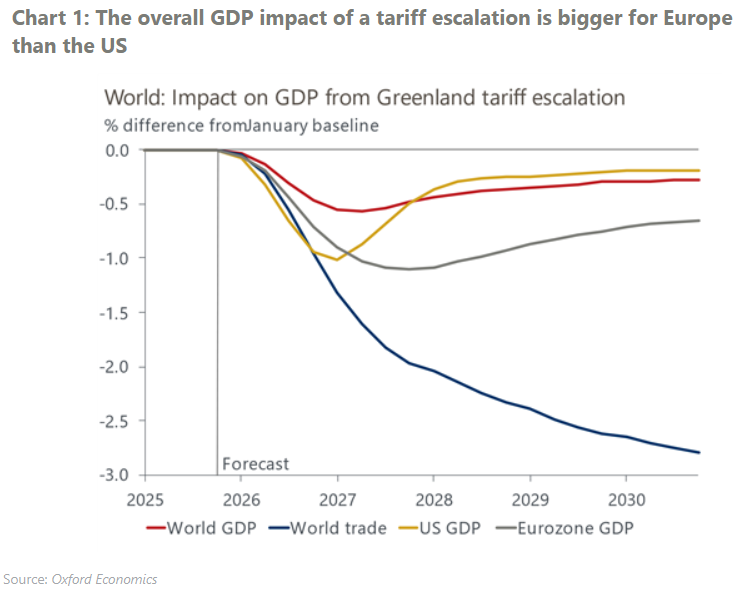
If the US carries out its threat and imposes an additional 25% tariff on European countries, and if there’s like-for-like retaliation, it would lower US GDP by 1% relative to our baseline at peak impact. The peak hit to the Eurozone would be similar, but more drawn out.
Given the size of both markets, this would lead to moderate spillovers to growth elsewhere, pushing global GDP growth down to 2.6%. That would be below the stable 2.8%-2.9% range of the past three years and the worst growth rate since 2009, excluding the Covid year of 2020.
A change to our baseline forecast in February will depend on the rhetoric over the coming days, whether the US carries out its tariff hike threat on February 1, and how willing European countries are to retaliate.