
Research Briefing | Jan 21, 2022

US and Canada housing affordability edged down in Q3
US and Canada housing affordability edged down in Q3 - iPad

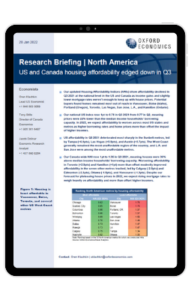
Our updated Housing Affordability Indices (HAIs) show affordability declined in Q3 2021 at the national level in the US and Canada as income gains and slightly lower mortgage rates weren’t enough to keep up with house prices. Potential buyers found homes remained most out of reach in Vancouver, Boise (Idaho), Portland (Oregon), Toronto, Las Vegas, San Jose, L.A., and Hamilton (Ontario).

What you will learn:

  • Our national US index rose 1pt to 0.78 in Q3 2021 from 0.77 in Q2, meaning prices were 22% lower than the median income households’ borrowing capacity.
  • US affordability in Q3 2021 deteriorated most sharply in the Sunbelt metros, led by Tampa (+6.9pts), Las Vegas (+5.9pts), and Austin (+5.7pts).
  • Our Canada-wide HAI rose 1pt to 1.36 in Q3 2021, meaning houses were 36% above median income households’ borrowing capacity.


Tags: AffordabilityCanadaCoronavirusHousing MarketMetrosNorth AmericaReal EstateUnited States
Back to Resource Hub

Related Services

Takaichi’s big win doesn’t affect the fiscal outlook for Japan

Takaichi’s big win doesn’t affect the fiscal outlook for Japan

The ruling Liberal Democratic Party's (LDP) landslide election victory on Sunday doesn't change our expectation of a primary fiscal deficit of 2%-3% of GDP in FY2026-FY2028 – we still see the deficit only starting to decline from FY2029. We also keep our view that the 10-year Japanese government bond (JGB) yield will be at 2.3% at end-2026 and 2.5% at end-2027 and beyond.
US and Chinese strength won’t boost all other economies

US and Chinese strength won’t boost all other economies

Upward revisions to US and Chinese GDP growth in Q4 meant that the previously anticipated soft end to 2025 failed to materialise.