

RESEARCH BRIEFING
27 Feb 2026
Iran and the Strait of Hormuz: risks to global energy prices
Tensions in Iran threaten global energy security through the risk of disruption in the Strait of Hormuz, the world’s most important energy trade route.
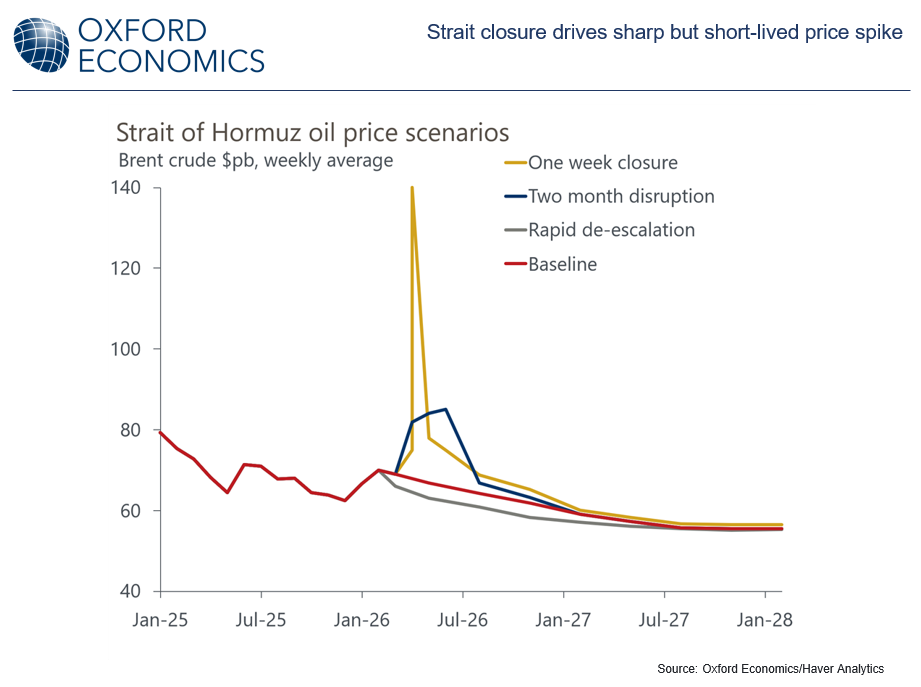
Around a fifth of global oil and LNG transits the Strait each day, worth over $1.3 billion including Iranian exports themselves. Our baseline (45% probability) is unchanged: we assume the Strait remains open and energy flows are not meaningfully disrupted.
- A more plausible upside risk for oil prices is low-level shipping disruption (30% probability), with repeated interference reducing traffic and raising costs while the Strait stays open. In our scenario, vessel traffic falls by 50% for two months and oil supply falls by 4 mbpd.
- A severe disruption is a tail risk (5% probability), as Iran would struggle to fully close, let alone sustain closure of, the Strait of Hormuz against a rapid international response. In this scenario, Iran halts transit for up to a week, pushing oil to $140 per barrel and gas above $40/MMBtu.
- The main downside risk for oil prices is faster de-escalation (20% probability). We expect the current geopolitical risk premium (around $9 per barrel) to unwind quickly if a US strike is avoided.
You might also be interested in
Tags: