
[Video] Inflationary and volatile: The new reality?
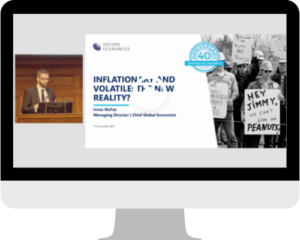
On Wednesday 3rd November, Oxford Economics hosted its quarterly UK & Global Outlook Conference. This invite-only event for our key clients and prospects is always a thoroughly enjoyable opportunity to catch up with familiar faces and new ones, but this event was a particularly special one for us, since we were also celebrating Oxford Economics’ 40th Anniversary!
To celebrate this milestone, we are offering our blog & social media followers the exclusive opportunity to watch all 3 sessions from the conference. To watch the first session ‘Inflationary and volatile: The new reality?’ by Innes McFee, complete the form today. Subscribe to the blog to be notified when we release session 2 (‘Can the recovery survive without policy?’) and session 3 (‘The economic transformation to meet net zero’).
Inflationary and volatile: The new reality? by Innes McFee
- Supply chain disruption, a new pattern of consumption and the tricky transition from public to private demand mean that 2022 is set to see the most uneven and volatile global economic recovery for some time.
- It also implies that fears about persistently high inflation have more foundation in some regions than others.
- But with the problem of excess global savings persisting, will there really be a lasting ‘regime change’ or will pre-Covid trends reassert themselves?