
Terms of trade will lift income but challenge Australian households
 The Russia-Ukraine conflict has generated another spike in Australia’s terms of trade. As energy importers look to substitute away from Russian exports, prices for several of Australia’s key export commodities have risen sharply. The surge in export prices is expected to be short-lived, although we do see gas prices settling at a higher level in the long-run due to the dislocation caused by the conflict.
Nevertheless, we do not expect firms will undertake new mining projects in Australia due to the current spike. Accordingly, this terms of trade episode will have limited impacts on the real economy, although government and corporate revenues will be boosted substantially by higher export prices.
Terms of trade will lift income but challenge Australian households
The Russia-Ukraine conflict has generated another spike in Australia’s terms of trade. As energy importers look to substitute away from Russian exports, prices for several of Australia’s key export commodities have risen sharply. The surge in export prices is expected to be short-lived, although we do see gas prices settling at a higher level in the long-run due to the dislocation caused by the conflict.
Nevertheless, we do not expect firms will undertake new mining projects in Australia due to the current spike. Accordingly, this terms of trade episode will have limited impacts on the real economy, although government and corporate revenues will be boosted substantially by higher export prices.







 The strong performance of the Australian economy over the past six months has led to a sizeable revision of Treasury’s projections for the budget deficit. Stronger-than-expected revenue growth means a deficit of 3.5% of GDP is now expected in FY22, down from 4.5% of GDP in the last MYEFO from October 2021. The ongoing strength in the labour market and higher commodity prices are the main sources of the revision to revenue projections.

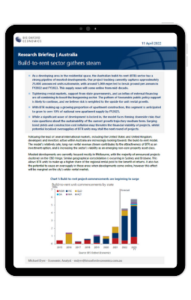 As a developing area in the residential space, the Australian build-to-rent (BTR) sector has a strong pipeline of mooted developments. Our project tracking currently captures approximately 25,000 announced units nationwide, with around 5,000 expected to break ground per annum in FY2022 and FY2023. This supply wave will come online from mid-decade. Tightening rental markets, support from state governments, and an influx of external financing are all combining to boost the burgeoning sector. The pattern of favourable public policy support is likely to continue, and we believe risk is weighted to the upside for unit rental growth. With BTR making up a growing proportion of apartment construction, this segment is anticipated to grow to over 10% of national new apartment supply by FY2025.


 After rising strongly last year, we forecast that GDP in Istanbul will grow at a slower pace of 2.5% in 2022. Part of this reflects an exhaustion of easy gains from re-opening the economy after lockdown. But higher energy prices and further uncertainty from Russia’s invasion of Ukraine are also set to weigh on near term growth prospects. Over the medium term (2022-26) we expect Istanbul’s GDP growth to average 2.7% per year, placing the Turkish capital in the middle tier of our European city rankings.

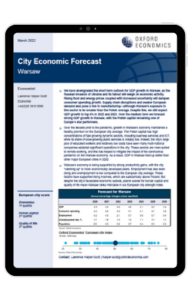 We have downgraded the short-term outlook for GDP growth in Warsaw, as the Russian invasion of Ukraine and its fallout will weigh on economic activity. Rising food and energy prices coupled with increased uncertainty will dampen consumer spending growth. Supply chain disruptions and weaker European demand also pose a risk to manufacturing—although Warsaw’s exposure to this sector is far smaller than the Polish average. Despite this, we still expect GDP growth to top 4% in 2022 and 2023. Over the medium term we forecast strong GDP growth in Warsaw, with the Polish capital remaining one of Europe’s star performers.

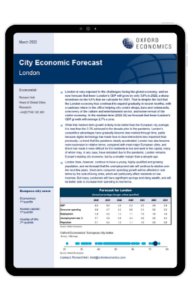 London is very exposed to the challenges facing the global economy, and we now forecast that Inner London’s GDP will grow by only 3.8% in 2022, a sharp slowdown on the 6.6% that we calculate for 2021. That is despite the fact that the London economy has continued to expand gradually in recent months, with a cautious return to the office helping city-centre shops, bars and restaurants, a recovery of the culture and entertainment sector, and some revival of the visitor economy. In the medium term (2022-26) we forecast that Inner London’s GDP growth will average 2.7% a year.

 Though not quite as rapidly as Phoenix, Denver has seen significant in-migration and job growth over the last two years. Employment in Q1 2022 had just recovered to Q1 2020 levels, making it rank in the top 20 of the 50 largest metros on this metric. Its GDP growth rate of 5.9% from Q4 2019 to Q1 2022 ranks 12th of the top 50 metros. We expect Denver to see job growth of 3.9% in 2022 but then slow to 1.0% on average from 2023 2026. In addition to restaurants, state and local government, construction, arts and recreation are expected to add the most jobs in the next five years. Led by air transport, real estate, and data processing and other information, GDP will grow 4.5% in 2022, then settle at 2.6% annually from 2023-2026, higher than the US rate of 2.1%.



 US retail real estate returns are expected to accelerate this year, reaching 4.4%, despite growing geopolitical uncertainty, higher inflation, and quantitative tightening. While capital growth will be a key driver of near-term gains, solid income return levels will continue to stabilise the growth path over the five-year forecast period. That said, retail is projected to be the weakest-performing real estate sector in the US. Even so, returns for both direct and listed real estate should comfortably outpace those of bonds and equities.