

A greener Australian economy is becoming inevitable


Policy inaction has left Australia a laggard among advanced economies in adopting lower net-emissions targets. But domestic climate policy could be about to change. With the Glasgow Climate Change Conference looming and pressure mounting on multiple fronts, the Morrison government is displaying a growing acceptance that a net-zero emissions target will need to be adopted.
Energy generation and distribution will be key to reaching any new commitments. Renewable energy investment has ramped up over the past decade, with 8.6% of Australia’s energy coming from renewables in 2019. But despite its comparative advantages in renewable energy generation, Australia’s renewables share is well below the global average of 11.4%. And it’s not just developed economies that lead Australia: China’s share of energy from renewables has jumped to 12.7%.
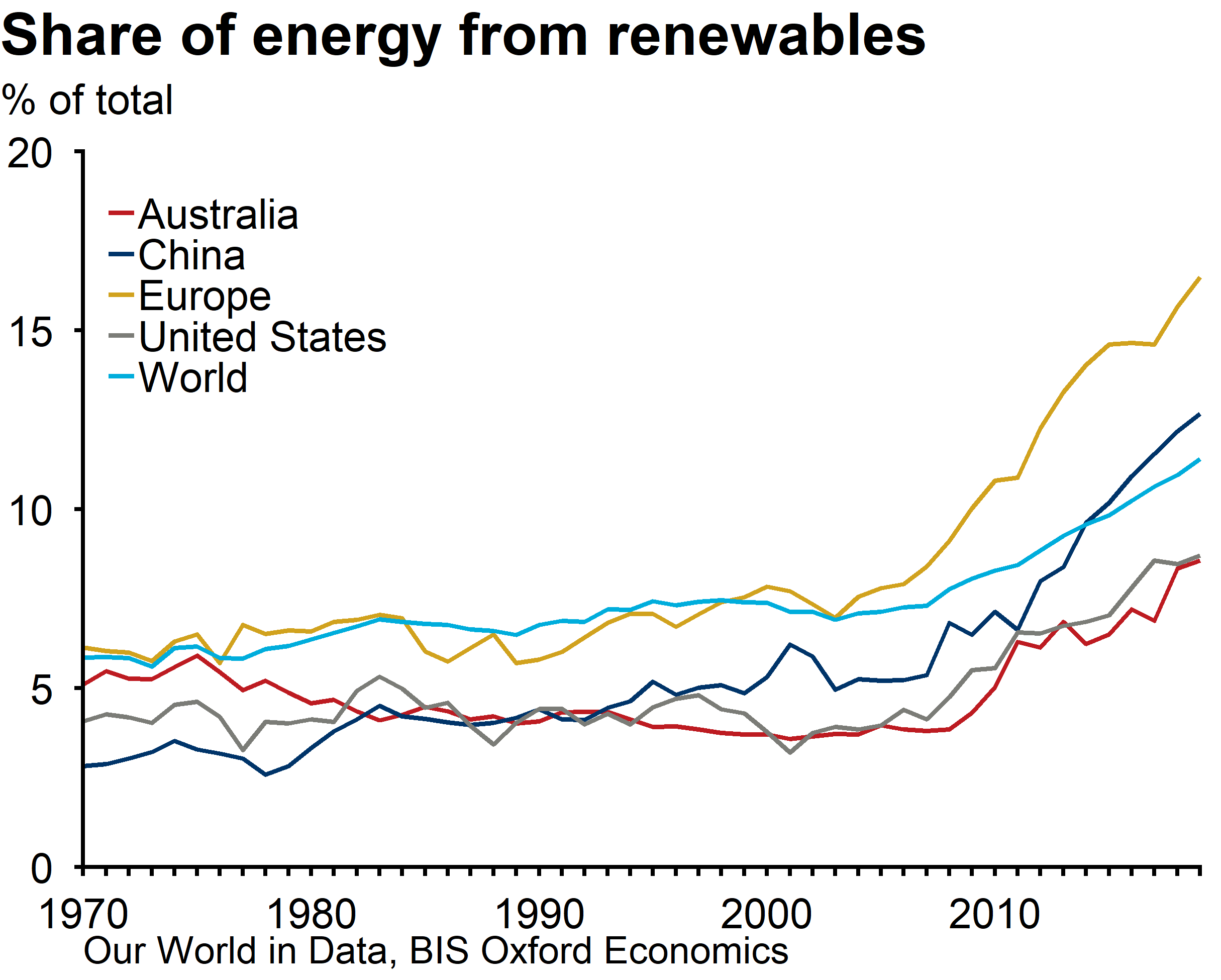 While the private sector has been responsive to falling renewable energy generation costs, policy uncertainty has prevented renewable energy from reaching its potential. For much of the past decade, ambiguity around the Renewable Energy Target (RET) at the federal level made for an unfavourable investment environment. The national RET has since lapsed, but state and territory governments are picking up the slack. Yet for progress to be made, greater leadership and investment in the distribution network and storage facilities of the grid will be needed.
The current reassessment of Australia’s emissions targets is being spurred by the actions of other governments and regulators, as well as the capital markets and investors:
- EU’s Carbon Border Adjustment Mechanism scheme will impose costs on exporters, highlighting that Australia’s domestic policies are running short of international norms.
- Capital markets are paying more attention to climate risk and mitigation policies; this could lead to higher borrowing costs for firms if Australia remains out of step with the world.
- Investor appetite for emissions-intensive industries is shifting, with some lenders beginning to categorise loans into ‘green’ or ‘brown’; plus, there’s a chance investors could levy a sovereign premium if Australia’s domestic policies fail to align with net-zero goals.
RBA and regulators have taken a broader approach to climate risk, which could increase costs for banks and borrowers; while recent work by financial regulators concluded that climate-change risks to the banking system are currently manageable, a transition away from emmissions-intensive industries presents a new source of risk for Australia’s banks.
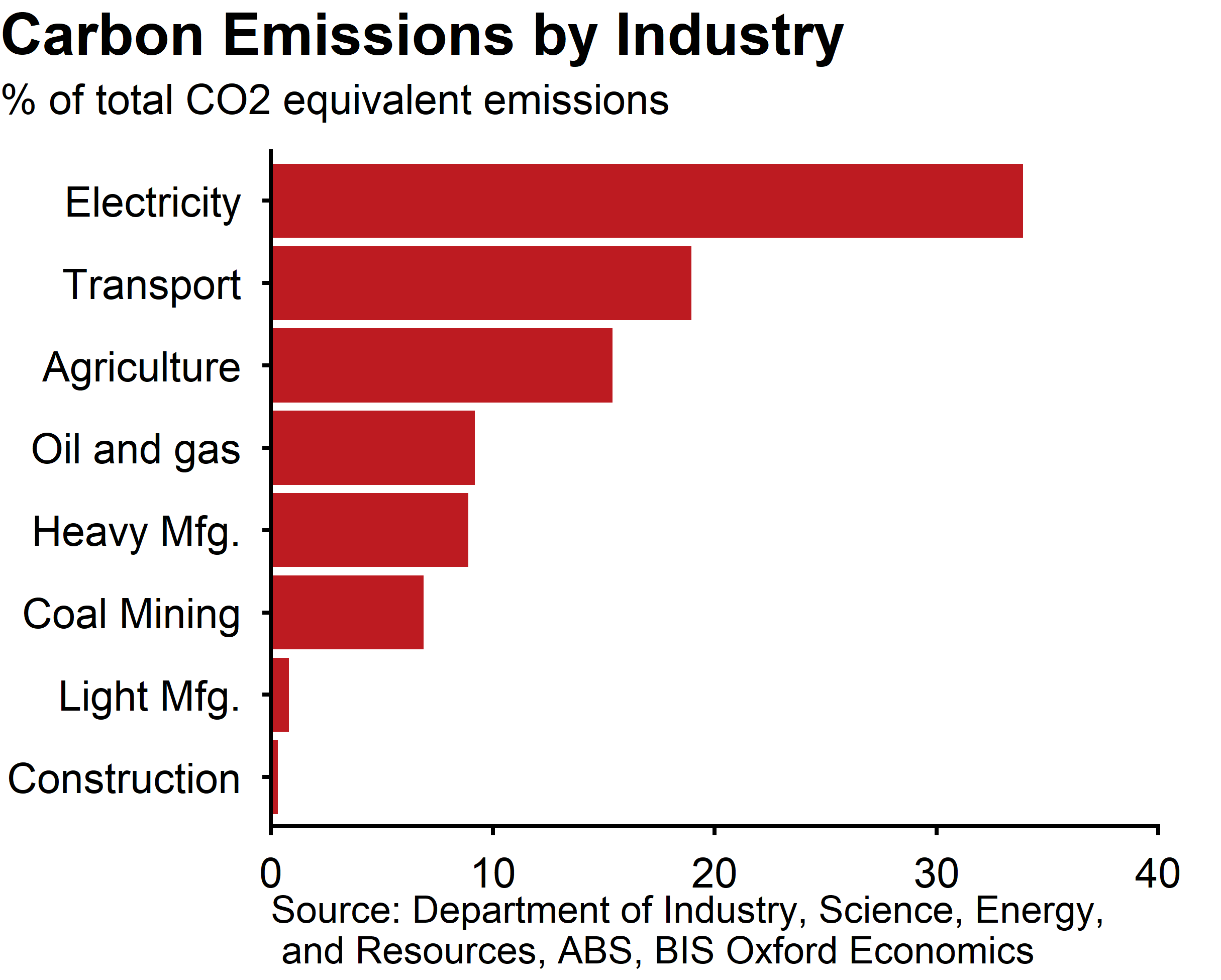 Shifting to a lower emissions target will weigh on GDP growth in the near term, given the economy’s weak starting point and the mining sector’s share of output. However, the hit to GDP will be smaller the sooner the target goal of net zero by 2050 is adopted. We expect the shift in government policy will be gradual, preventing a sharp decline in output and supporting affected industries. But there are upside opportunities from a shift to a greener economy domestically and abroad. With ready access to hydro, solar, and wind resources, Australia is well positioned to become a net exporter of clean energy; plus, green hydrogen export projects are already in the works.
Tags: