

What is English devolution and what are the likely next steps?
English devolution is accelerating, but revenue retention risks deepening regional inequality.

With Andy Burnham expected to step into Number 10 next week, devolution has shot up the political agenda. While this is unsurprising given that Burnham made his name as the Mayor of Greater Manchester, the extent to which it is now dominating his vision for the country is striking.
For those only newly attuned to devolution as a concept in England, the basic premise is that power and funding from the centre are relocated to devolved regional institutions like Mayoral Authorities. It is not the same thing as redistributing funds from wealthier regions to poorer ones, nor is it civil service relocations from London to the regions, although these both form part of Burnham’s wider vision. The devolution agenda is ultimately about where power sits.
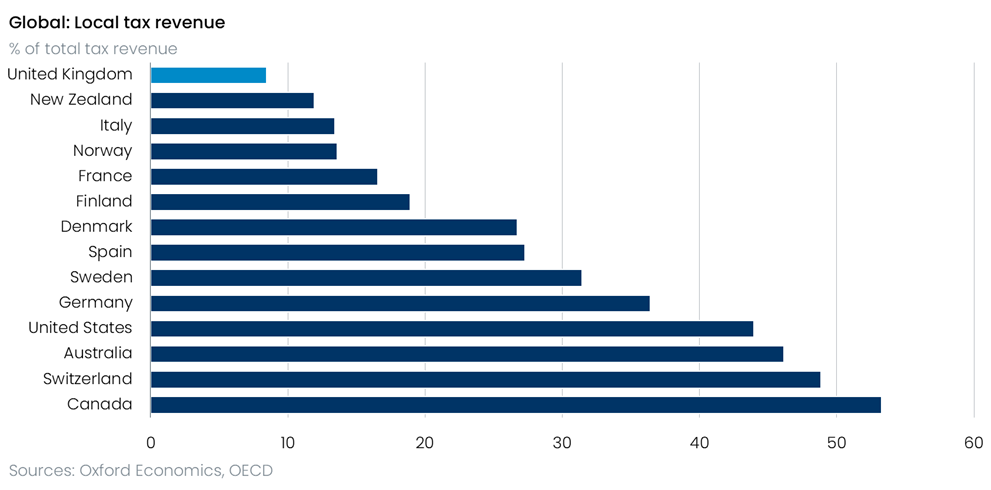
As the UK is one of the most centralised nations in the world, with over 90% of tax revenue collected by the central government, there are many policy options for the incoming government to consider (Chart 1). But they will not be starting from scratch. The current iteration of the UK’s devolution agenda has actually been around for almost three decades, spanning the Blair government, the coalition, and was central to the ambition of the previous Conservative government. The UK now has Devolved Administrations with a range of powers in Scotland, Wales, and Northern Ireland, as well as series of Mayoral Authorities built around England’s city-regions.
Chart 1: The UK has one of the most centralised tax systems in the world
Previous momentum can be characterised as gradual, aimed at building up the capacity and maturity of existing Mayoral Authorities, while also adding new authorities to the map to ensure that a growing share of the country is covered by devolution deals. The recent major milestone has been the development of the Integrated Settlement, designed to bring together a range of central government funds and grants under one budget for Mayoral Authorities. The goal is to give them more flexibility as to how funds are spent, along with longer-term certainty over their budgets.
Despite the rhetoric, we don’t think this gradualist approach will change. Mayoral Authorities will continue to spread across the map, with limited initial powers growing as institutional capacity develops. Where there are already mature and capable Mayoral Authorities, such as in the West Midlands and Greater Manchester, we expect the range of powers to widen, direct budget accountability to grow, and some powers over revenue retention to be devolved. This latter point is something the current Chancellor set out during her Mais lecture in March, and it is something that Burnham has been a strong advocate for over several years.
Our view of continued gradualism is not to downplay these specific policies or that the incoming administration will not hasten the decentralisation process. There has been substantial opposition to English devolution across Whitehall departments and particularly in the Treasury for decades, as they fear a loss of control over spending and a patchwork of confusing policies developing across England’s geography. Increased fiscal devolution, particularly in the form of incremental revenue retention, is a major step forward and builds on the recent progress towards giving mayors the power to charge a visitor levy on overnight stays. In fact, that powers over a visitor levy are not already in the hands of mayors shows how far England still has to go to meaningfully devolve power to the local level.
What will not happen in the medium-term is significant progress on rate-setting or debt-raising powers. Indeed, it isn’t being prioritised right now by Burnham, was ruled out by the Chancellor in her Mais lecture (which gives a good indication of the Treasury view), and it would be highly contentious.
The biggest step forward, and challenge, will therefore be delivering an expanded form of incremental revenue retention for the most established Mayoral Authorities. It will likely involve agreeing to a baseline level of revenue and where the authority delivers revenues exceeding this, they would get to keep a share. It is designed to raise the incentives for local leaders to pursue economic growth-enhancing policies as they can reap the benefits.
Several challenges arise from this. First, how do you set the percentage for what authorities keep? Second, where do you set the baseline level of revenue after which the apportionment jumps in? Third, how do you manage a settlement that, for the foreseeable future, will only be available to the handful of established Mayoral Authorities, while most of England remains on the existing system?
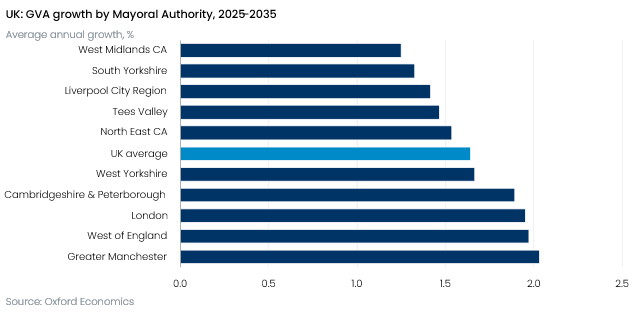
Most challenging, however, is how do you prevent the policy from embedding regional inequality? For example, looking at our latest medium-term growth projections you can see that the fastest growing Mayoral Authorities are typically the UK’s wealthiest, like London, while the slowest growing are concentrated in the lowest productivity regions, such as West Midlands and South Yorkshire (Chart 2). If policy is designed to allow the fastest-growing Mayoral Authorities to keep more of their revenues, weaker regions could fall into a self-fulfilling cycle of weak growth, limited scope for investment, drained revenues, and yet weaker growth.
Chart 2: We forecast stronger medium-term GVA growth in already more prosperous authorities.
The third point, the coverage question, will likely resolve itself over time as more authorities complete reorganisation and build the institutional maturity to qualify, although this itself risks reinforcing a cycle where the most capable places pull further ahead. The harder, more enduring problem for an incoming government pushing revenue retention is the fourth point: how to maintain the growth incentive that makes revenue retention attractive while limiting the regional inequality it risks entrenching.
Request a free trial
Complete the form and we will contact you to set up your free trial. Please note that trials are only available for qualified users. We are committed to protecting your right to privacy and ensuring the privacy and security of your personal information. We will not share your personal information with other individuals or organisations without your permission.