
Research Briefing
| Dec 11, 2024
Trump’s tariffs will likely exacerbate the slowbalisation globally
Our latest economic forecasts assume Trump will impose a 30% across-the-board tariff on Chinese imports into the US, a 25% tariff on selected goods from Europe including steel, aluminium, and automobiles, and a 10% tariff on selected goods in Canada, Mexico, Japan, South Korea, and Vietnam. This would take the effective tariff rate on US goods imports to around 6% from 2%.
What you will learn:
- Donald Trump’s victory in the US elections heralds a potential upheaval in global trade. We don’t know exactly what tariffs Trump will enact, but his campaign rhetoric and his political appointments so far suggest he will implement significant changes to policy.
- From Trump’s first term, we’ve learnt that trade wars affect a broad range of goods, not just those facing tariffs. So, the hit to trade outside of China may extend beyond the selected goods on which we expect tariffs will be applied.
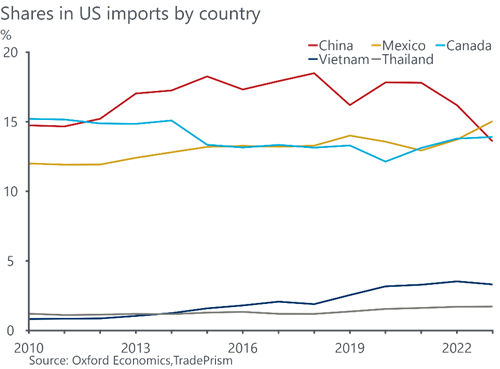
- New tariffs on China would intensify its decoupling from the US which has already been building over the past eight years. On top of this, the inclusion of Asia in the next phase of tariffs would limit the ability to reduce the hit from higher tariffs by rerouting trade. Consequently, we think Trump 2.0 will add to the slowbalisation that is already taking place.
- We expect Trump’s tariffs will reduce global trade values by more than 7% by 2030 compared to our pre-election forecasts. By contrast, we only anticipate a modest 1.8% hit to nominal GDP over the same period.