

The ‘YES’ Economy: Giving the world financial identity
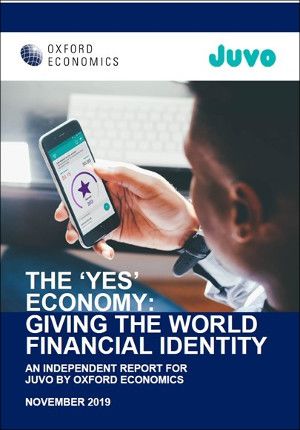
More than five billion individuals around the world own and use a mobile phone. This network of mobile phone users stretches far beyond the boundaries of the global financial system. Individuals that have never been granted access to financial services are welcomed into a valuable network of digital participants. The connections they make within that network present a profound opportunity for the financial services sector, as well as for the well being of the world’s recently connected populations.
In this study for Juvo, a pioneer of Financial Identity as a Service (FiDaaS) technology, we found that establishing financial identities for the world’s financially excluded – or "unbanked" – population would add an extra $250 billion to global GDP. That is the equivalent to increasing GDP per capita in low-income countries by 6%, simply from utilising the data already being shared via mobile phone usage.
We explored the implications for household savings, credit and insurance provision of providing the opportunity for a global network of smartphone users, to access financial services for the first time. For a region-by-region breakdown and our assessment of the socio-economic implications of such a scenario, visit the Juvo landing page to read the report in full.
Our economic consulting team are world leaders in quantitative economic analysis, working with clients around the globe and across sectors to build models, forecast markets and evaluate interventions using state-of-the art techniques. Lead consultants on this project were:
Oxford Economics’ team is expert at applying advanced economic tools that provide valuable insights into today’s most pressing business, financial,and policy issues.
To find out more about our capabilities, contact:
EMEA
Sam Moore
+44 (0)203 910 8082
Email
Americas
Hamilton Galloway
+1 (646) 503 3068
Email
Asia
Christie Tang
+852 3974 8841
Email