

How to address skills mismatch for better productivity

Make the Match, Lift the Nation
How fixing the mismatch and mobility can lift Australia’s productivity
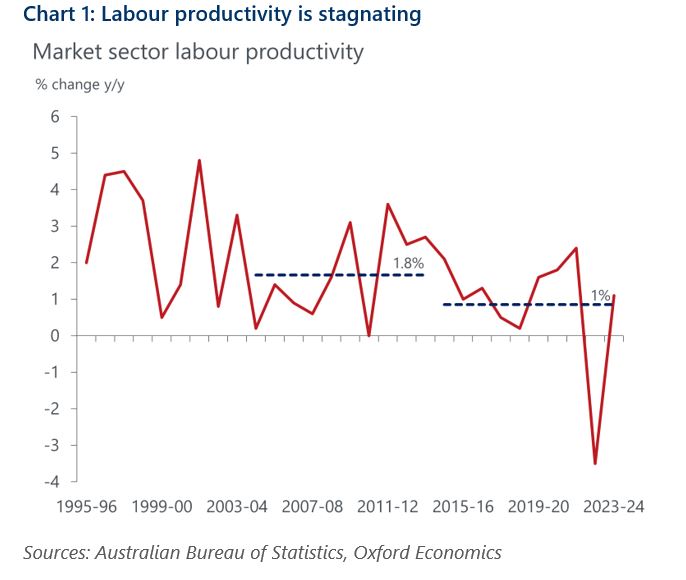
Stagnant Australian productivity has kept real wages and living standards essentially stuck. Average growth in labour productivity has halved from 1.8% to just 1.0% over the past decade. The issue isn’t effort but allocation: skills aren’t being deployed to their highest and best use.
A failure to get the right skills, in the right place, at the right time
While many factors contribute to weaker labour productivity, one issue that stands out is skills mismatch. Too many Australians aren’t using the qualifications they’ve invested in, and too many jobs can’t find the core skills that make teams productive. That double‑mismatch drags on output per hour and slows innovation.
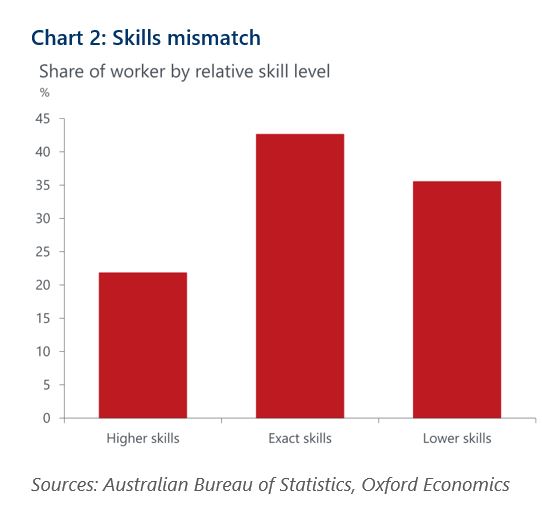
This isn’t just the familiar story of people lacking the right skills, but also of existing skills being deployed in the wrong places. Around 20% of workers believe their highest non-school qualifications are not relevant to their role. When we analyse the qualifications that workers hold and the skill level required in their role, we estimate that nearly a quarter are overqualified for their work and another third are relying on work experience to fill the gap in their formal qualifications. With Australia investing billions into tertiary education each year, this represents a significant hit to return on investment.
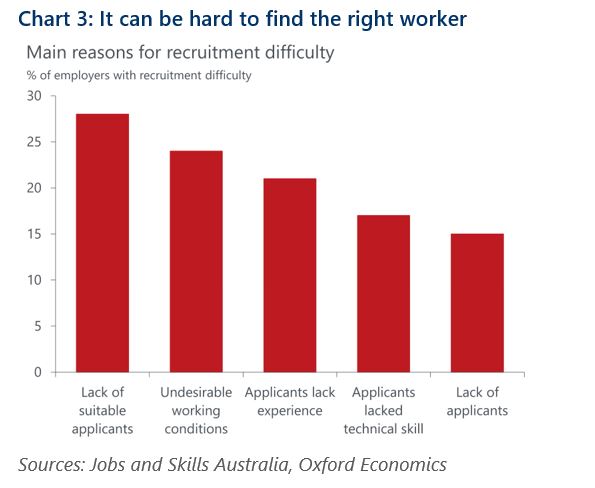
Skill shortages and challenges aren’t only found in workers’ technical tickets, but also in the core competencies that cut across all jobs, such as digital literacy, problem‑solving, planning & organising, communication, teamwork, learning agility, and initiative & innovation. Among employers finding it hard to recruit, 39% cited a “lack of suitable applicants”, with 16% blaming “applicants lacking technical skills”, according to Jobs and Skills Australia’s recruitment difficulty update to May 2024 spotlight. Without these skills, workers can’t operate at the top of their band, even if the qualification is right.
Connect with an economist for deeper insight
Get in touchAn agile workforce will be critical for future labour productivity
The nature of work is changing, fast. AI is rapidly re-assigning routine information-processing tasks to software, and re-bundling jobs around human judgment, coordination and care. The World Economic Forum projects 1 in 5 jobs are likely to undergo structural transformation by 2030, with advances in AI and information‑processing expected to transform the majority of businesses. With this will come increased demand for technical skills in AI & big data, as well as core competencies across analytical thinking, technological literacy, and resilience, flexibility & agility.
The changing nature of work requires a workforce that is adaptable (can move between roles) and a training system that gets bang for buck (supports workers to operate at the top of their band by filling the missing gaps).
What can policymakers do?
In its recent Building a Skilled and Adaptable Workforce interim report, the Productivity Commission identifies important reforms to help workers pivot to where they are needed most. These include:

- Easing occupational entry regulations to reduce unnecessary credential requirements that lock qualified people out of roles
- Recognition of prior learning and credit transfer, allowing workers to carry their existing skills into new roles or sectors more easily.
- SME training incentives to encourage small and medium enterprises to invest more in upskilling their people.
These steps support mobility and adaptability, which will be critical for a modern, flexible economy. However, they may not go far enough in addressing the underlying skills mismatch problem that is hampering labour productivity.
Australia invests heavily in training, but too much of that investment flows into the wrong areas. This mismatch can happen when training is not aligned with industry needs and education is too narrowly focused, limiting the portability of skills. The outcome? A constant churn of retraining without a corresponding lift in Australian productivity.
There are two areas where policy has the potential to play a bigger role
- Embed industry in qualification delivery by expanding models where formal qualifications are co-delivered by education providers and industry. This goes beyond traditional apprenticeships to include solutions such as higher apprenticeships, dual-study programs, and work-integrated bachelor degrees. This type of solution will limit the mismatch between training pipelines and job-specific needs by bringing industry to the table early.
- Create a national core skills guarantee that embeds and assesses a minimum standard of transferable skills alongside technical competencies. This ensures that no matter what sector someone trains in, they leave with a baseline capability set that is valued in multiple industries. This builds on the momentum developed through the University Accord, which highlighted the value of student-centric lifelong skills and the establishment of an Australian Tertiary Education Commission to guide system alignment.








Tags: