
The world’s top-performing cities in 2026
European and North American cities dominate the upper reaches
The 2026 update of our Global Cities Index reflects the latest assessment of the structural advantages, opportunities, and challenges facing cities. Bringing together five categories, Economics, Human Capital, Quality of Life, Environment, and Governance, the index embeds a thorough assessment of each city’s standing in the global landscape.
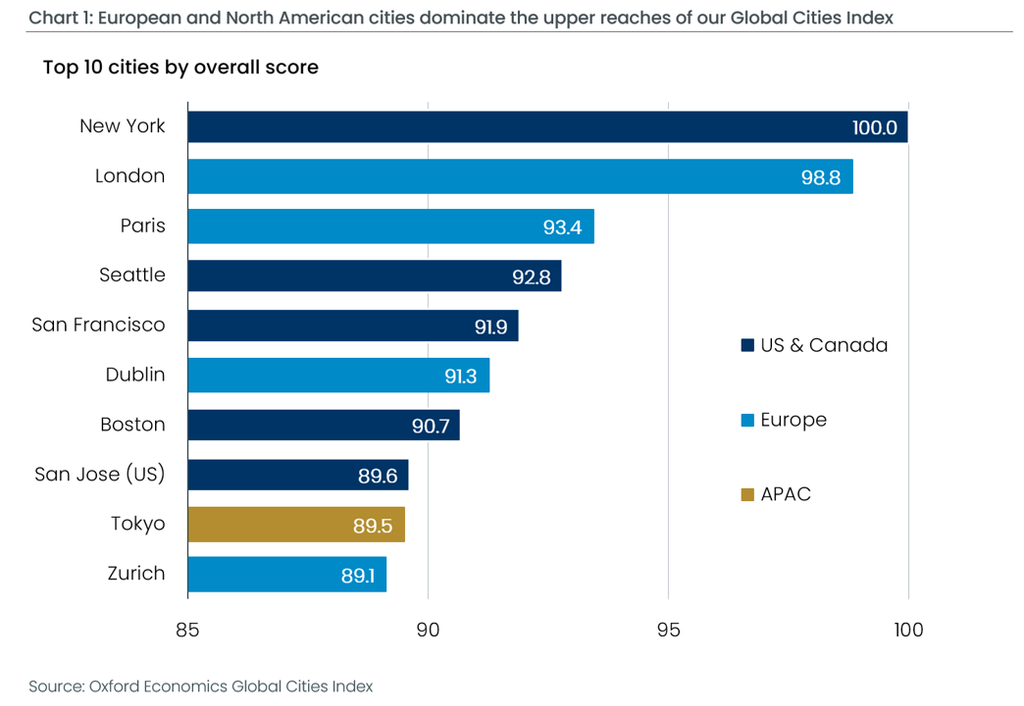
New York and London remain at the pinnacle, largely due to the size of their economies and the strength of their labour market (Chart 1). Paris rounds off an unchanged top three from last year, performing particularly well on quality-of-life measures. Indeed, eight of the top 10 are unchanged from last year, with Seattle, San Francisco, Dublin, Boston, San Jose, Tokyo, and Zurich making up the remaining spots. The enduring strength of these global leaders highlights the resilience and self-reinforcing nature of success among cities at the very top of our index, with several years of weak growth or political upheaval failing to fundamentally alter the nature of what makes these superstar cities attractive places to live and work.
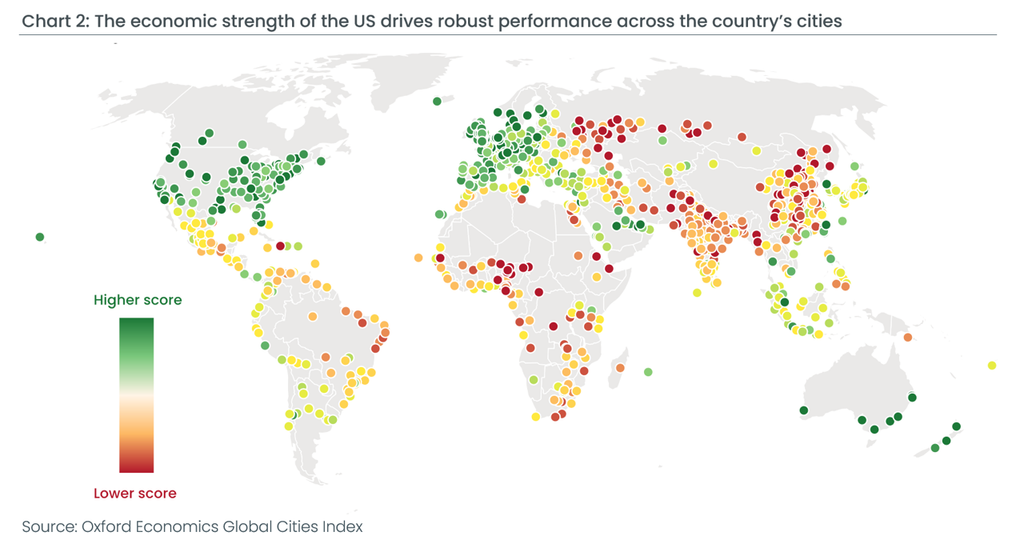
As is immediately visible, cities across North America and Europe dominate the top echelons of the index, with the US alone accounting for 30 of the top 100 cities (Chart 2). Yet the drivers of this dominance differ between the two regions. In the US, it is strong scores across the Economics and Human Capital categories that drive their elevated position. In Europe, however, it is outperformance across the Quality of Life, Environmental, and Governance categories. These differences are reflective of current trends and policy priorities, as the US continues to post strong economic gains, while Europe retains its advantage in resident amenities and liveability.
While different factors drive the strong performance of these global leaders, they are all united by their outsized ability to attract the very highest skilled workers and most innovative businesses. The strength of these highflyers lies in their relatively broad success across all the categories in our Global Cities Index, highlighting the overlapping nature of performance: strong performance in one category tends to elevate performance in another, allowing the strongest cities to fall into virtuous cycles of improvement.
Emblematic of this virtuous cycle are cities across Australia, Switzerland, and the Nordics. While Melbourne and Sydney drop out of the top 10 this year, largely due to weaker GDP and employment growth projections over the next five years, they continue to see strong broad-based performance and remain 13th and 16th, respectively. In fact, all of Australia’s cities that feature in our index are in the top 100, with five in the top 50. The same holds true for Swiss and Nordic cities, where strong Governance, Environmental, and Quality of Life scores drive their outperformance.
Asia’s cities are closing the gap
The strong performance of the largest cities will continue. This is largely because their sheer size means that even small rates of growth will deliver huge absolute gains to their economies, which is a significant driver of overall score. However, as we have seen over recent decades, the global economy is shifting eastward. This will have significant implications for our rankings, as cities across Eastern and Southern Asia, Central and Eastern Europe, and the Middle East close the gap on their advanced economy peers. The scale of growth occurring in Asia specifically can be seen in Chart 3, with five of the 10 largest GDP increases over the period to 2050 found here. It is worth noting, however, that Tokyo’s substantial gains are more akin to London and New York’s than other Asian economies, given that the city is one of the largest and most advanced in the world.
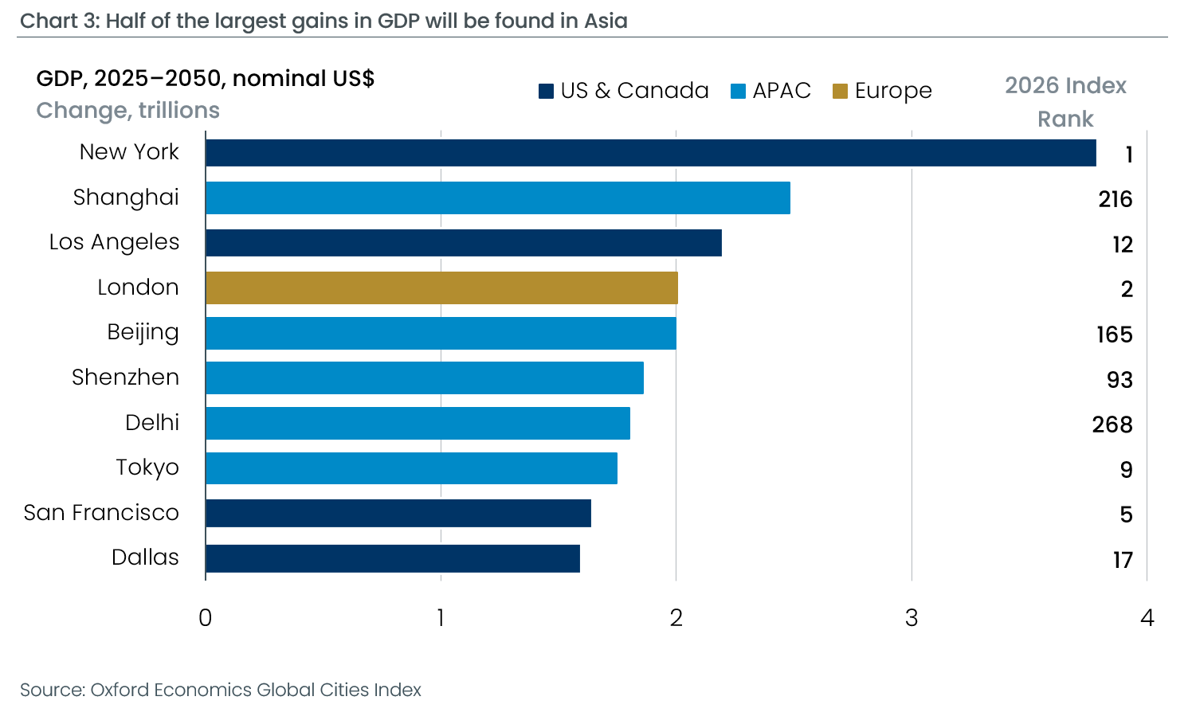
The real story comes from Chinese and Indian cities. They will be at the forefront of global growth, combining large population size with significant gains in productivity and income. Shanghai, Beijing, and Delhi are all currently ranked outside the top 100 in our index, but they will see some of the largest increases in GDP. By 2050, we project the Chinese and Indian share of GDP across our major global cities to be above that of Europe, while Shanghai’s GDP is set to overtake San Francisco next year. This is despite Shanghai being just a quarter of its size at the turn of the millennium.
Cities across the Middle East are also increasingly prominent in our global rankings. Both Dubai and Riyadh have entered the top 50 this year, following several decades of economic and social transformation. Cities across the region have leveraged vast sovereign wealth funds to develop strong infrastructure, improve quality of life, and increasingly attract the world’s best and brightest workers and companies. While the conflict in Iran threatens to undermine this hugely successful growth model, we continue to expect cities across the Middle East to drive significant growth.
The same is true in Central and Eastern Europe, as cities in the region deliver some of the largest improvements in the index. Strong economic and income growth has been central to these developments, capping off over two decades of transformation since the ascension into the European Union. Warsaw rose 109 places since last year, as it moved closer to the top 50, while Bratislava and Sofia also delivered huge increases. Prague is the highest-ranked city in the region, placing 51st this year. Our current projections suggest cities like Prague, Warsaw, and Tallinn will top European economic growth rankings in the coming years, helping them close the gap on their Western peers.
Top 10 cities in the 2026 Global Cities Index
- New York
- London
- Paris
- Seattle
- San Francisco
- Dublin
- Boston
- San Jose (US)
- Tokyo
- Zurich
To explore the full rankings and see how other cities perform, visit the 2026 Global Cities Index site.
You might also be interested in
Explore the 2026 Global Cities Index
REQUEST A TRIAL
Access detailed city analysis and forecasts with a free trial of our cities and regions services.
