
The top Canadian cities in 2026
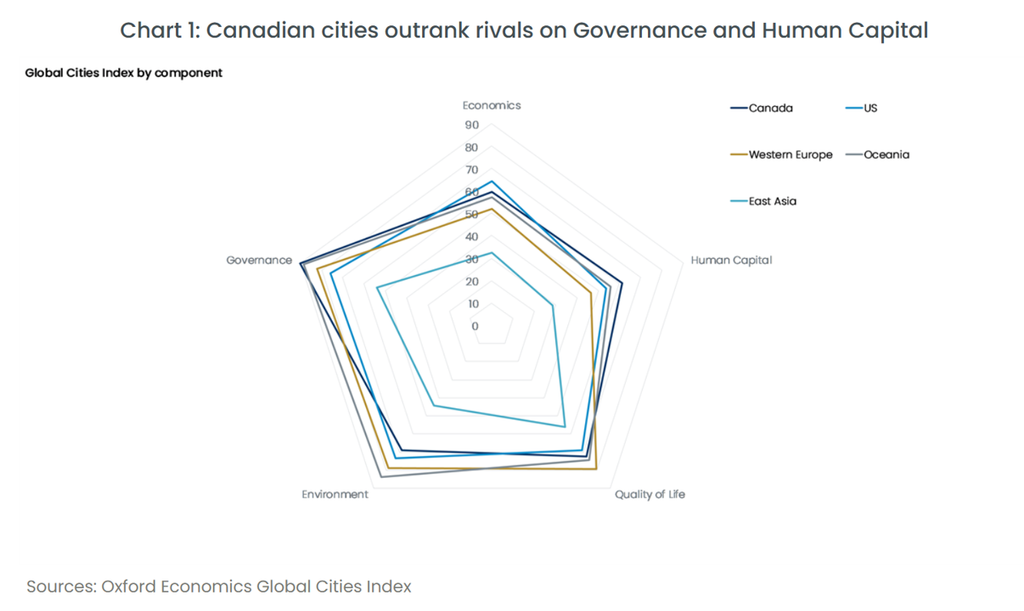
Driven by a strong economy and favourable quality of life measures, Canada’s major cities continue to offer significant benefits to the world’s highest-skilled workers. On average, Canadian cities outscore the US on Human Capital, Governance, and Quality of Life, but lag marginally on Economics and Environment where three of the bottom four scores in North America belong to Canadian cities. This partly reflects the country’s seasonal weather fluctuations, which drag on their Environment scores.
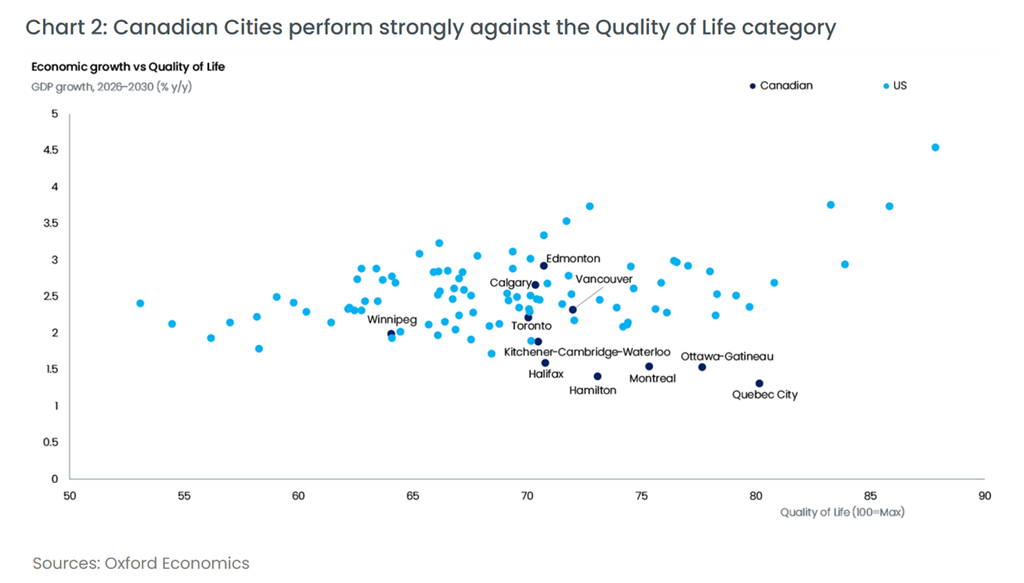
The majority of Canadian cities are set to grow at a slower rate than US cities over the next five years, with the exception of oil-rich Edmonton and Calgary. However, the Canadian cities tend to average higher on Quality of Life score, with a more even income distribution, higher life expectancy, and lower crime rates.
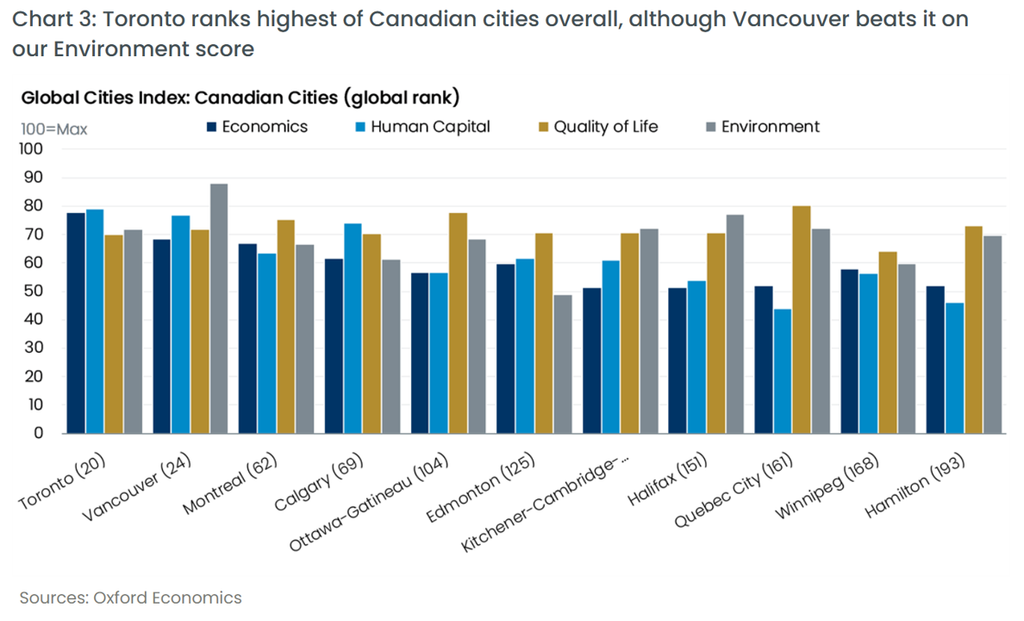
In our 2026 Global Cities Index, Toronto is the top-ranking Canadian city overall, placing 20th in the world out of 1,000 cities. As Canada’s premier centre for business, finance, culture, and art, it performs best in the Economics and Human Capital categories. It is an economic powerhouse and continues to boast some of the most robust employment growth rates in the region, with migrants attracted to its buoyant jobs market and high-wage sectors. Lower immigration targets announced by the federal government in 2025 have slowed the pace of growth compared with 2022–2024, but the city is not alone in Canada or the wider Western world in facing demographic challenges.
Canada’s other major cities also score highly in our index, and like Toronto, they tend to have their strongest results in the Economics and Human Capital metrics. Vancouver ranks 24th globally and second in Canada, above US powerhouses such as Miami and San Diego. This is largely due to the city’s tech and business services sectors, which have underpinned Vancouver’s steady economic growth over the past decade and attracted workers and businesses from around the world. In fact, many US tech firms have established offices in Vancouver to more easily recruit talent from overseas. Unlike some other Canadian metros, Vancouver also performs well in the Environment category. It boasts very good air quality, and the city has historically been proactive in implementing well-defined energy transition and climate adaptation plans.
Montreal, Canada’s third-ranked city, places 62nd globally. Its economic outlook is slightly cloudier than Toronto’s and Vancouver’s, but the city still scores in the top decile globally thanks to its large economy, high life expectancy, and skilled workforce. In fact, Montreal is a key hub for education and innovation in the country and globally: it is home to McGill University, a global leader in medical research, and is also a hub for AI research and video game development, attracting skilled professionals from around the world.
In a similar vein, Calgary (fourth in Canada, 69th globally) and Ottawa-Gatineau (fifth in Canada, 104th globally) are regional bright spots with strong Human Capital scores. Ottawa-Gatineau has high levels of educational attainment thanks to its large government and public policy-adjacent sectors, while Calgary is home to many corporate headquarters and leads the country in population growth thanks to high incomes and easy access to national parks.
Calgary’s Albertan neighbour, Edmonton, is a place we have designated as a ‘City to Watch’ in the coming years. While not quite at the same level as Canada’s other major metros, partly due to its dependence on oil refining, Edmonton is a city we believe is primed to move up the rankings at pace, through a process of self-reinforcing economic growth and business development. It is among North America’s fastest-growing urban economies, recording strong gains in GDP, employment, and population. And this robust economic growth will have positive downstream effects: disposable incomes in the city, which are already higher than the national average, are set to rise at one of the fastest rates in Canada, boosting consumer spending.
House prices are still relatively affordable in Edmonton too, which cannot be said for many other Canadian cities. Residents of Toronto and Vancouver in particular typically spend a larger portion of their income on housing than residents in nearly every other city in the world. High housing costs have pulled down the Quality of Life scores for several Canadian cities, and is an enduring challenge for local and provincial governments around the country.
The other key challenge currently facing Canadian cities is the trade war with the US. The volatility around the USMCA renegotiations and broader uncertainty have stymied business investment in the country and harmed the economies of export-producing cities. The oil exporters Edmonton and Calgary have largely been spared as Canadian oil exports have targeted non-US markets with the aid of the Trans Mountain Pipeline and shipping from Vancouver. However, the manufacturing sectors of Toronto, Montreal, and Hamilton have been hit hard, both directly and through the higher cost of input materials. In our index, Hamilton ranks very similarly overall to Detroit and Pittsburgh, two cities with a similar industrial heritage and exposed to the current uncertainty.
Top 10 Canadian cities in 2026 Global Cities Index
- Toronto
- Vancouver
- Montreal
- Calgary
- Ottawa–Gatineau
- Edmonton
- Kitchener–Cambridge–Waterloo
- Halifax
- Quebec City
- Winnipeg
- Hamilton
To explore the full rankings and see how other cities perform, visit the 2026 Global Cities Index site.
You might also be interested in
Explore the 2026 Global Cities Index
REQUEST A TRIAL
Access detailed city analysis and forecasts with a free trial of our cities and regions services.
