OE Logo
Ungated Post|10 January 2017

Top ten calls for 2017 — Trumpenomics leads the way
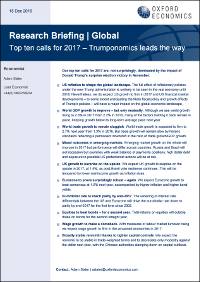
Top ten calls for 2017 — Trumpenomics leads the way

Our top ten calls for 2017 are, not surprisingly, dominated by the impact of Donald Trump’s surprise election victory in November. The full effect of reflationary policies under the new Trump administration is unlikely to be seen in the real economy until 2018 with world GDP growth and trade growth remaining moderate next year. Nevertheless, we do expect US growth to firm in 2017 and US financial market developments – to some extent anticipating the likely fiscal policy and growth effects of Trump’s policies – will have a major impact on the global economic landscape. 

Read more

Ungated Post|10 January 2017

Global scenarios service — Trump towers over the global economy

Global scenarios service — Trump towers over the global economy

The global economic outlook has shifted markedly in the three months since our last report. While our baseline forecast has changed only modestly, upside risks to growth have increased significantly and we no longer judge risks to be skewed to the downside. As highlighted in the latest Oxford Economics Global Risk Survey, the greatest source of risk is the US policy stance once President-elect Trump takes office.

Read more

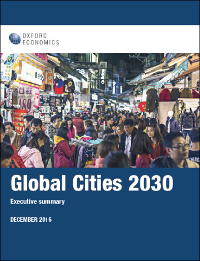
The economic landscape is changing, with the world’s urban centre continuing to shift Eastwards. Aggregate GDP of Chinese cities covered in the report will overtake the largest cities in Europe and North America by 2017 and 2022 respectively. Nine additional Chinese cities will join the world’s top 100 ranked by real GDP in 2030, with 13 cities from North America and Europe dropping out. Despite this shift, the top five largest city economies in 2030 will remain unchanged from today.

Ungated Post|10 January 2017

Brexit: Who Could Take London’s Place in the EU?

Brexit: Who Could Take London’s Place in the EU?

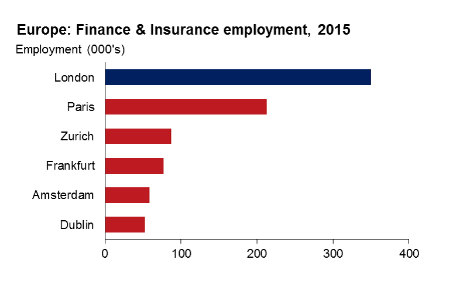
In considering the risk that London may shed financial services jobs as a result of Brexit, we do need to consider whether any alternative EU city has the capacity to absorb the jobs that London loses.

Read more

Ungated Post|10 January 2017

Expansion of US metro service to cover 500 counties

Expansion of US metro service to cover 500 counties

usmetros.png

The North American Metro Service provides historical data, forecasts, and written analysis of all 50 states and Washington DC, and 89 Metropolitan Statistical Areas that make up the majority of US economic activity. We will shortly expand the coverage to include additional coverage of 500 counties to provide a more granular view of US economic prospects.

Read more

Oxford Economics were appointed by the Gatwick Growth Board (GGB) to provide an independent assessment of Gatwick Airport’s local, regional and national impact. The GGB was established in 2016 to examine the economic and social consequences of Gatwic

The US-China Business Council commissioned Oxford Economics to assess the overall impact of the trade and economic relationship with China on the US economy. The study shows that today, the US-China trade relationship actually supports roughly 2.6 mi

Breaking new ground in macro research, Oxford Economics has captured current and historical statistics on bilateral trade in services for 24 key trading nations to build a unique, comprehensive database. These previously elusive data give us unpreced

Ungated Post|13 December 2016

Trump and Technology

Trump and Technology

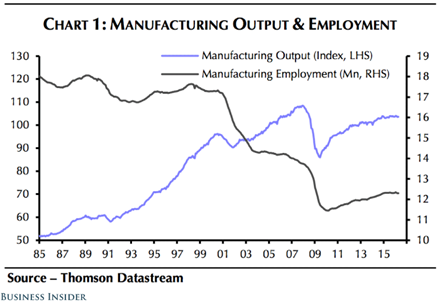
If the most iconic American job ever is riding the range as a cowboy, then rolling down the highway as a long-haul trucker is somewhere on the short list. Now, 159 years after a patent was issued for the technology (barbed wire) that would end mass employment for the cowpoke, technology in the form of self-driving vehicles is threatening to reduce the role of the truck driver—one of the most common occupations in the country.

Read more

Ungated Post|7 December 2016

The largest 100 cities: a clear shift Eastwards

The largest 100 cities: a clear shift Eastwards

We expect significant changes in the world economic order over the next decade and a half. Not surprisingly, Chinese cities will be at the forefront of these changes. The aggregate GDP of China’s 150 largest cities is forecast to double from around US$10 trillion today to US$20 trillion in 2030 (measured in 2012 prices and exchange rates). This means that Chinese cities will account for almost half of the increase in global city GDP and will represent a third of total urban GDP by 2030. By contrast, the combined output of the 58 North American cities covered in our analysis will rise by US$4.0 trillion, followed by non-Chinese Asian cities (US$3.5 trillion) and then European cities (US$3.2 trillion). 

Read more

Ungated Post|6 December 2016

Asian Cities & Regions Outlook December 2016

Asian Cities & Regions Outlook December 2016

Delhi is fastest emerging city, Brisbane fastest advanced 
Indian cities feature strongly amongst the fastest growing Asian cities in the period to 2020, with Ho Chi Minh City also standing out, and Chinese cities having to adapt to a more service sector reliant growth model. The advanced economy cities face challenges from their emerging rivals, with a marked contrast between Japan’s sclerotic cities and rivals such as Seoul and Singapore. 

Read more

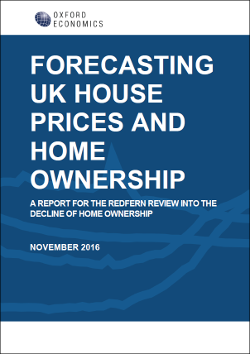
This report sets out a new approach to modelling the macroeconomic drivers of house prices and home ownership based on data from 1992 to 2014. This approach enables us to explore the drivers, outlook and policy options for the housing market in a mor

Innovation and rapid adjustments to changing customers and markets lies at the heart of today’s competitive world. All companies are being pulled toward the center of a “Digital Vortex,” which is characterized by exponential change and the blurring o

This study, done in collaboration with the Mental Health Foundation, explores the experiences of people with mental health problems, assesses their contribution to the UK economy, and estimates the costs that mental health problems impose on the UK e

air travel
Ungated Post|14 November 2016

The Effect of a Trump Presidency on International Travel to the US

The Effect of a Trump Presidency on International Travel to the US

The election of Donald Trump has introduced new uncertainty into the outlook for the US travel industry. While a Clinton presidency would have been broadly considered a continuation of existing policies, Trump ran a campaign calling for shifts in foreign, fiscal, trade, and immigration policies that have potentially significant implications for the global economy and travel. 

Oxford Economics has separately analyzed Trump’s proposals and assessed a range of risks to the US economy. The conclusion of this analysis is that the most likely scenario involves significantly watered-down positions that would produce only marginally slower economic growth in 2017 and 2018 relative to our pre-election baseline scenario.

Read more

News|1 November 2016

Oxford Economists Develop a New Global Impact Model

Oxford Economists Develop a New Global Impact Model

globallinkages.pngEconomic impact assessments provide a clear insight into how a firms operations and interactions with suppliers generates economic activity. They capture how supply chains spread through an economy, enabling us to quantify a firm’s footprint.

Yet typically they only consider a firm’s operations and spending in one country. For some companies this may be ideal: for instance if they have a single location and spend little with suppliers in other economies. But for globally integrated businesses, such analysis does not capture the impact on a local economy in its entirety.

Traditionally a firm’s operations and suppliers outside of the main country of analysis, as well as trade impact they have on an economy, have been beyond the capacity of standard impact models. Such activities are known as ‘leakage’ from the analysis. These limitations have meant conventional impact studies inevitably understate a global company’s national economic contribution, although they still quantify important effects.

Read more

Heritage tourism is a vital part of the UK economy. In 2015, domestic and international tourists made 192 million trips to visit the UK’s cultural, historic and natural heritage assets.

The heritage tourism sector supported a £20.2 billion gross v

While UK insurers opposed Brexit, they should use the Brexit vote as an opportunity to foster invention and transformation to secure the future of the UK insurance sector as a world leader in innovation, customer responsiveness and development, and d

Some 167,000 independent financial advisors are represented by the Financial Services Institute (FSI), accounting for approximately 64.5 percent of financial advisors countrywide. They are affiliated with the more than 100 independent financial servi

Traditional financial services business models are under the microscope. For most financial organizations, sustained profitability is a challenge in today’s lower-interest rate environment. Competition from new market entrants is also generating new