

US hyperlocal forecasts: The economy, neighborhood by neighborhood
What if we could forecast not just how a city will grow, but precisely where that growth is expected to happen?
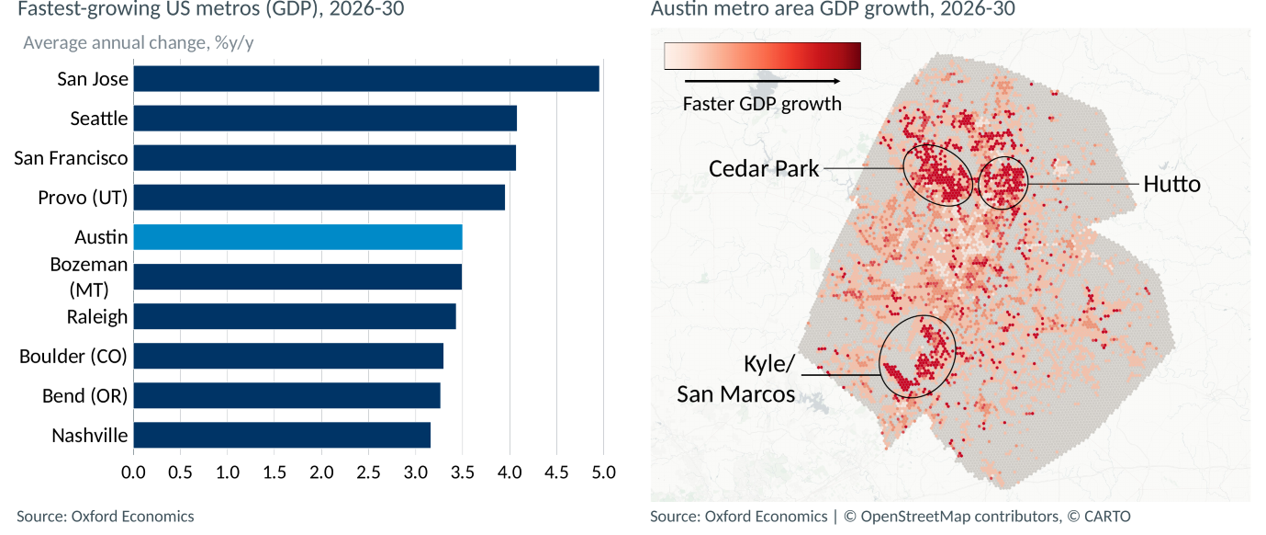
At Oxford Economics, we are taking economic forecasting to a new level of detail. Building on our established national, regional and city forecasts, we are developing US hyperlocal forecasts, providing a forward-looking view of employment, population, income and other economic indicators at neighborhood level across the United States.
How do we forecast at neighborhood level?
Most local forecasts share out regional growth in proportion to what is already there. Our model explains why activity moves, and how a change in one neighborhood ripples through the rest of the city.
- A stable grid. We use H3 hexagons roughly 1 km across. Unlike census tracts and ZIP codes, they’re uniform and never get redrawn, keeping time series consistent while letting you aggregate data into any custom geography.
- Trusted data. Built on a range of official US Census Bureau datasets (including ACS and LODES), enriched with property prices, building footprints and heights, peak-time travel times between every pair of locations, and our own proprietary analysis to create a robust and consistent view.
- Grounded in where buildings are. Census tract data is allocated to hexagons using building footprints, so people and jobs land on real development, not empty land.
- A behavioral model of the city. Our quantitative spatial equilibrium model represents how households choose where to live and work, how firms choose where to locate and hire, and where developers build. Wages, rents and commuting adjust until the city reaches balance. For sparsely populated, largely rural areas (about 20% of the population) we use a shift-share approach.
- Consistent with the bigger picture. Hexagon results add up to Oxford Economics’ published national, state, metro and county forecasts.
Be among the first to explore US hyperlocal forecasts
We are bringing these forecasting capabilities together with new location intelligence tools, designed to help businesses, investors and policymakers explore future economic trends and make more informed location decisions.
We are starting with 10 priority US markets, offering a select group of clients early access to trial the service and help shape its development ahead of the full launch.
Interested in early access? Complete the form to register your interest.
