
US Recession Monitor – Slowdown but no downturn yet
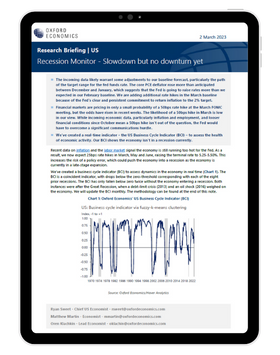
The incoming data likely warrant some adjustments to our baseline forecast, particularly the path of the target range for the fed funds rate. The core PCE deflator rose more than anticipated between December and January, which suggests that the Fed is going to raise rates more than we expected in our February baseline. We are adding additional rate hikes in the March baseline because of the Fed’s clear and persistent commitment to return inflation to the 2% target.
What you will learn:
- Financial markets are pricing in only a small probability of a 50bps rate hike at the March FOMC meeting, but the odds have risen in recent weeks. The likelihood of a 50bps hike in March is low in our view. While incoming economic data, particularly inflation and employment, and looser financial conditions since October mean a 50bps hike isn’t out of the question, the Fed would have to overcome a significant communications hurdle.
- We’ve created a real-time indicator – the US Business Cycle Indicator (BCI) – to assess the health of economic activity. Our BCI shows the economy isn’t in a recession currently.
- The latest BCI reading of 0.37 for January (up from 0.33 in December) signals the economy isn’t in a recession, though it has passed a turning point. We expect recession to coincide with a reading in the range of -0.25 to -0.50. The BCI partly underpins our decision to push back the start of the recession to Q3 2023 in our upcoming March baseline.
Tags:
Related Resources

Post
US Key Themes 2026: Exceptionalism amid fragmentation
US exceptionalism is alive and well, and that won't change in 2026.
Find Out More
Post
US Bifurcated ꟷ Economic backdrop deepens racial disparities
Black and Hispanic households have experienced more inflation than other groups since the reopening of the economy from the pandemic lockdowns. Although there've been many phases of high inflation, some have disproportionately hurt these minority groups, such as the jump in energy prices following Russia's invasion of Ukraine, with the ensuing surge in rental inflation further setting them back.
Find Out More
Post
US economic outlook 2026: Four key calls for the year
US exceptionalism will continue in 2026—but so will the vulnerabilities beneath the surface.
Find Out More