
Industry is performing worse than the broader economy globally
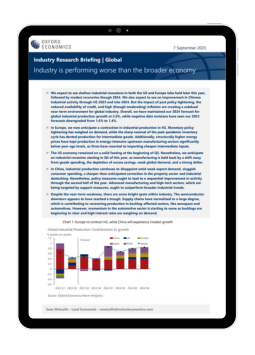
We expect to see shallow industrial recessions in both the US and Europe take hold later this year, followed by modest recoveries though 2024. We also expect to see an improvement in Chinese industrial activity through H2 2023 and into 2024. But the impact of past policy tightening, the reduced availability of credit, and high (though moderating) inflation are creating a subdued near-term environment for global industry.
What you will learn:
- The US economy remained on a solid footing at the beginning of Q3. Nonetheless, we anticipate an industrial recession starting in Q4 of this year.
- In China, industrial production continues to disappoint amid weak export demand, sluggish consumer spending, a sharper-than-anticipated correction in the property sector and industrial destocking. Nonetheless, advanced manufacturing and high-tech sectors, which are being targeted by support measures, ought to outperform broader industrial trends.
- Despite the near-term weakness, there are some bright spots within industry. The semiconductor downturn appears to have reached a trough. Supply chains have normalised to a large degree, which is contributing to recovering production in backlog-affected sectors.
Tags:
Related Posts
Post
Industry key themes 2026: Industry will grow if you know where to look
Prospects appear solid for global industry in 2026, but activity is set to remain regionally and sectorally divergent.
Find Out More
Post
Australia’s Infrastructure Outlook: Big Shifts, Bigger Challenges
Australia’s infrastructure landscape is shifting fast, driven by new investment trends, emerging asset classes and growing capacity constraints. This outlook explores the major changes ahead and what industry and government must do to navigate the decade effectively.
Find Out More
Post
Peak tariff impact on industry still to come
In 2026, we anticipate global industrial value-added output to grow just 1.9%, the slowest pace of growth since the global financial crisis.
Find Out More