
EV shift could pose a big challenge to Japanese economy
Amid the fast-progressing electric vehicle (EV) shift, maintaining high competitiveness in auto-related sectors and ensuring a smooth labour transition across industries are crucial for the growth of the Japanese economy. As auto production shifts towards EVs, which require different inputs from traditional internal combustion engine cars, parts suppliers will need to adapt to avoid losing market share to foreign players. Change in automotive supply chains would also require workers to move across different industries, a task particularly challenging for Japan.
What you will learn:
- The Japanese economy is reliant on the auto industry, as the sector accounts for 15% of industrial production. Furthermore, the sector has one of the highest multiplier effects, given breadth and depth of its supply chains. Spillover effects are seen not just in auto parts, but also among commerce, plastics, electronics, and metal industries.
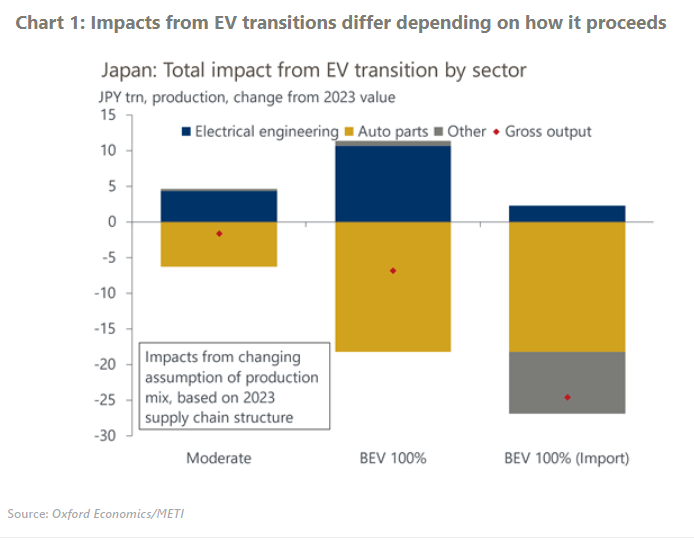
- The EV transition would bring about a huge change to the current supply chain structure. While demand for parts like electric motors and lithium-ion batteries will increase, there would be less demand for engines and transmissions. Our analysis reveals that the economy will be hit as EV transition proceeds, but the magnitude will depend on the nature of the transition.
- There would be a limited impact if hybrid vehicles retain as high a share of production as the Japanese government currently expects. However, if the entire auto production shifts to battery EVs, Japanese gross nominal output would be 0.6% lower than the 2023 level.
- Because the EV transition will reshape the industry structure, a smooth reallocation of labour across industries is imperative for the transition to work. Otherwise, capacity of EV goods providers will be strained, potentially raising the import dependency of the sector. We simulated a scenario where a considerable part of the input for battery EVs is sourced from abroad, in which case 2.2% of Japan’s gross nominal output and 1.1% of total employment will be lost.
Tags:
Related Posts

Post
Japan’s fiscal policy will remain loose, which increases risks to debt sustainabilit
We've changed our fiscal outlook for Japan in our December forecast round. We now expect the new government to set a primary deficit close to that of 2024, at 2%-3% of GDP for 2025-2027, instead of restoring a balanced budget by taking advantage of strong tax revenue. We assume higher bond yields will force the government to take measures to reduce the deficit from 2028.
Find Out More
Post
Japan’s politics add uncertainty to BoJ policy outlook
The Bank of Japan (BoJ) kept its policy rate at 0.5% at its October meeting, after a 7-2 majority vote. Two board members again voted for a rate increase. We believe the BoJ will hike in December to 0.75% as incoming data confirm that the economy is performing in line with the bank's forecasts in its quarterly outlook. However, there's a material chance of a delay.
Find Out More
Post
Japan’s December rate hike appears likely, though there is a risk of delay
We've brought forward the timing of the next Bank of Japan (BoJ) 25bps rate hike to December from next year and have added another 25bps hike in mid-2026. This reflects the surprisingly hawkish shift in the BoJ's view since its September policy meeting and upward revisions to our growth and inflation projections, driven by the US economy's resilience.
Find Out More