
The most important elections in 2023 in Africa
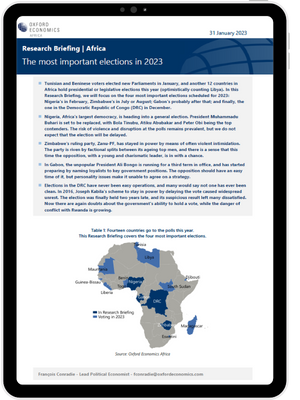
Tunisian and Beninese voters elected new Parliaments in January, and another 12 countries in Africa hold presidential or legislative elections this year (optimistically counting Libya). In this Research Briefing, we will focus on the four most important elections scheduled for 2023: Nigeria’s in February, Zimbabwe’s in July or August; Gabon’s probably after that; and finally, the one in the Democratic Republic of Congo (DRC) in December.
What you will learn:
- Nigeria, Africa’s largest democracy, is heading into a general election. President Muhammadu Buhari is set to be replaced, with Bola Tinubu, Atiku Abubakar and Peter Obi being the top contenders. The risk of violence and disruption at the polls remains prevalent, but we do not expect that the election will be delayed.
- Zimbabwe‘s ruling party, Zanu-PF, has stayed in power by means of often violent intimidation. The party is riven by factional splits between its ageing top men, and there is a sense that this time the opposition, with a young and charismatic leader, is in with a chance.
- In Gabon, the unpopular President Ali Bongo is running for a third term in office, and has started preparing by naming loyalists to key government positions. The opposition should have an easy time of it, but personality issues make it unable to agree on a strategy.
- Elections in the DRC have never been easy operations, and many would say not one has ever been clean. In 2016, Joseph Kabila’s scheme to stay in power by delaying the vote caused widespread unrest. The election was finally held two years late, and its suspicious result left many dissatisfied. Now there are again doubts about the government’s ability to hold a vote, while the danger of conflict with Rwanda is growing.
Tags:
Related Resouces

Post
The Green Leap: More promises but little innovation at COP30
The COP30 in November made some ambitious commitments to scaling up climate finance. Until those materialise, initiatives to leverage natural endowments for financing may be more attractive to African countries, especially those with high forest cover.
Find Out More
Post
The Green Leap: Unlocking climate financing at COP30 for Africa
The scaling of climate finance for developing countries will take centre stage at the 30th Conference of the Parties (COP30) of the UN Framework Convention on Climate Change (UNFCCC) starting today, in Brazil. Leaders will grapple with how to plug the gaping shortfall in funds needed to help developing economies curb emissions and adapt to climate shocks. Reforming the global financial architecture will be a key discussion.
Find Out More
Post
Continental oil kings missing out on evolving oil dynamics
Uncertainty around global growth has widened the range of possible outcomes for oil consumption. While demand growth currently lags behind supply, stronger-than-expected trade or industrial activity could lift demand above projections. This brief explores whether Nigeria and Algeria are positioned to take advantage of such an upside.
Find Out More