

Research Briefing
| Aug 9, 2023
The impact of climate transition policies on the US Southwest
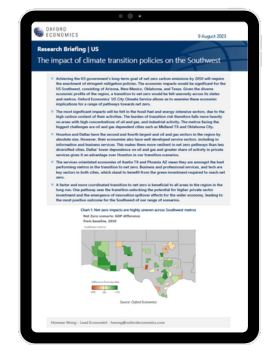
Achieving the US government’s long-term goal of net zero carbon emissions by 2050 will require the enactment of stringent mitigation policies. The economic impacts would be significant for the US Southwest, consisting of Arizona, New Mexico, Oklahoma, and Texas. Given the diverse economic profile of the region, a transition to net zero would be felt unevenly across its states and metros. Oxford Economics’ US City Climate Service allows us to examine these economic implications for a range of pathways towards net zero.
What you will learn:
- The most significant impacts will be felt in the fossil fuel and energy-intensive sectors, due to the high carbon content of their activities. The burden of transition risk therefore falls more heavily on areas with high concentrations of oil and gas, and industrial activity. The metros facing the biggest challenges are oil and gas dependent cities such as Midland TX and Oklahoma City.
- Houston and Dallas have the second and fourth largest and oil and gas sectors in the region by absolute size. However, their economies also have well developed service sectors, including in information and business services. This makes them more resilient in net zero pathways than less diversified cities. Dallas’ lower dependence on oil and gas and greater share of activity in private services gives it an advantage over Houston in our transition scenarios.
- The services-orientated economies of Austin TX and Phoenix AZ mean they are amongst the best performing metros in the transition to net zero. Business and professional services, and tech are key sectors in both cities, which stand to benefit from the green investment required to reach net zero.