
Scaling the great wall of trade barriers in Australia
Previous work identified which goods exports would be most affected by sanctions from China by constructing a ‘vulnerability score’ for each product. A product is considered to be more vulnerable if a large share of exports go to China and if China’s share of global imports is large. On the supply side, goods are more vulnerable if Australia makes up a small share of Chinese imports and a small share of global exports.
What you will learn:
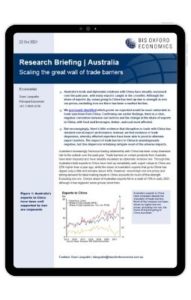
- Australia’s trade and diplomatic relations with China have steadily worsened over the past year, with many exports caught in the crossfire. Although the share of exports (by value) going to China has held up due to strength in iron ore prices, excluding iron ore there has been a marked decline.
- We previously identified which goods we expected would be most vulnerable to trade sanctions from China. Confirming our earlier findings, there is a clear, negative correlation between our metrics and the change in the share of exports to China, with food and beverages, timber, and coal most affected.
- But encouragingly, there’s little evidence that disruption to trade with China has derailed overall export performance. Instead, we find evidence of trade dispersion, whereby affected exporters have been able to pivot to alternate export markets. The impact of trade barriers to China is unambiguously negative, but this dispersion is helping mitigate most of the adverse impacts.
Tags:
Related Services

Post
US Key Themes 2026: Exceptionalism amid fragmentation
US exceptionalism is alive and well, and that won't change in 2026.
Find Out More
Post
Global Key themes 2026: Bullish on US despite AI bubble fears
We anticipate another year of broadly steady and unexceptional global GDP growth, but with some more interesting stories running below the surface.
Find Out More