
Recession would severely impact near-term property returns
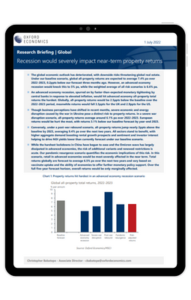
The global economic outlook has shifted drastically in the three months since our last global real estate scenario research briefing. The war in Ukraine introduced a significant amount of uncertainty into geopolitics and the outlook for the global economy, with downside risks accumulating since then. Over the past few months, we’ve gradually downgraded our global economic growth forecast, while upward revisions to the global inflation forecasts have seemingly been unremittent. Our most recent June flash Global Risk Survey suggests a shift in business perceptions about the key risks to the global economic outlook. While still pervasive, the war in Ukraine is no longer the prime concern of the Oxford Economics’ clients canvassed. Instead, it’s been supplanted in the latest survey by the risk of an advanced economy recession, on the back of quickening central bank tightening (Chart 2).
What you will learn:
-
The global economic outlook has deteriorated, with downside risks threatening global real estate. Under our baseline scenario, global all-property returns are expected to average 7.4% pa over 2022-2023, 0.2ppts below our forecast three months ago. However, an advanced economy recession would knock this to 5% pa, while the weighted average of all risk scenarios is 6.6% pa.
-
An advanced economy recession, spurred on by faster-than-expected monetary tightening by central banks in response to elevated inflation, would hit advanced economy all-property total returns the hardest. Globally, all-property returns would be 2.5ppts below the baseline over the 2022-2023 period, meanwhile returns would fall 3.5ppts for the UK and 2.9ppts for the US.
-
Though business perceptions have shifted in recent months, severe economic and energy disruption caused by the war in Ukraine pose a distinct risk to property returns. In a severe war disruption scenario, all-property returns average around 6.1% pa over 2022-2023. European returns would be hurt the most, with returns 3.1% below our baseline forecast by year-end 2023.
Tags:
Related posts

Post
Real Estate Key Themes 2026: CRE deal recovery delayed, not derailed
Real estate is still poised for a revival in 2026. Although 2025’s deal recovery was delayed, the key fundamentals remain in place for renewed momentum.
Find Out More
Post
Student housing makes the grade in Australia
Rising student demand and limited housing availability are pushing rents higher and reinforcing investor confidence in Australia’s student accommodation market.
Find Out More
Post
Inflation and bond yield shocks in Europe affect RE returns the most
Our modelling shows European real estate is most exposed to inflation and bond-yield shocks, with impacts varying widely across cities and sectors.
Find Out More