
Recent Release | 16 Mar 2021
Is your capital allocation strategy a long-term plan or a short-term fix?

Thought Leadership Team
Oxford Economics

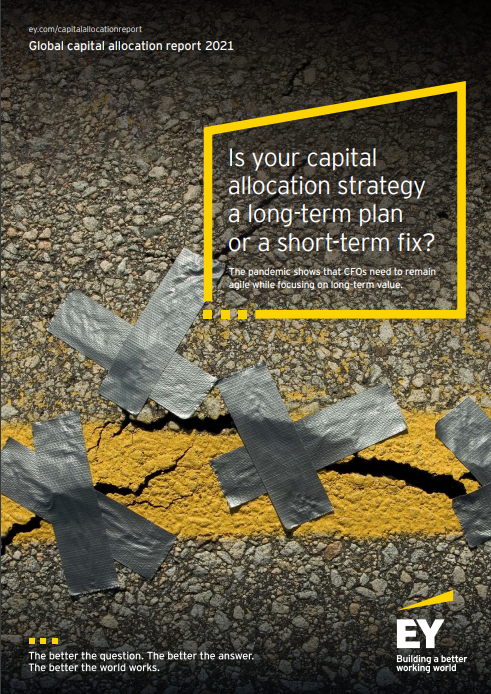
Chief financial officers are recovering from a once-in-a-generation shock to their capital allocation strategies. Even as they deal with the upheaval induced by the COVID-19 pandemic, they must make plans to improve long-term business performance. This means developing a capital allocation process that is fit for a future that may be radically transformed by the impact of digital technologies, a changing workplace and evolving business models.
How can CFOs develop the right capital allocation strategy and process while investment decisions are being scrutinized by investors and employees, regulators and society at large?
To better understand how businesses are addressing market changes – and how they should adapt their capital allocation strategies going forward – EY and Oxford Economics surveyed 1,050 CFOs around the world and across industries in the first weeks of 2021. Read the report now to learn more.
About the team
Our Thought Leadership team produces original, evidence-based research made accessible to decision-makers and opinion leaders. Principals for this project included:

Edward Cone
Editorial Director, Thought Leadership
Edward Cone
Editorial Director, Thought Leadership
New York, United States
Editorial Director Edward Cone oversees global research programs for our Thought Leadership group. As Technology Practice Lead he works with clients such as Google, Accenture, IBM, SAP, and many others. His areas of focus include Artificial Intelligence, the impact of technology on business performance, and healthcare organizations.
Edward joined the firm in 2012 after more than two decades as a business and technology journalist based in New York, Paris, and North Carolina, including stints as an editor and writer at various Ziff Davis magazines (CIO Insight, Baseline), a contributing editor at Wired, and a staff writer at Forbes.
Edward also wrote a weekly newspaper opinion column for many years in his hometown of Greensboro, NC and authored a semi-popular blog. He has contributed to a bewildering variety of magazines and papers on topics ranging from politics to rock climbing and was a frequent speaker and organizer at new media conferences across the country. Honors for his work include the 2020 Rybczynski Prize, awarded for the best essay on economics by Society of Professional Economists, and various awards from the American Society of Business Publication Editors and the North Carolina Press Association. He has a BA from Haverford College.
Related Services

Post
KPMG M&A Outlook 2026: Between Uncertainty, Resilience, and Seizing Opportunities
Discover how Germany’s M&A landscape is evolving – with a focus on growth, AI and post-merger value creation.
Find Out More
Post
Silver, the next generation metal
This report highlights the critical role silver plays in data centres and artificial intelligence (AI), automotive and electric vehicles (EVs), and solar energy photovoltaics (PVs). With these sectors expected to expand significantly over the coming years, we expect future silver demand to be strong.
Find Out More
Post
Powering the UK Data Boom: The Nuclear Solution to the UK’s Data Centre Energy Crunch
The UK’s data centre sector is expanding rapidly as digitalisation, cloud computing, and artificial intelligence (AI) drive surging demand for high-performance computing infrastructure.
Find Out More