
How to improve the fiscal rules
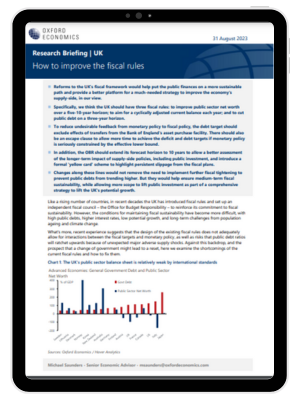
Reforms to the UK’s fiscal framework would help put the public finances on a more sustainable path and provide a better platform for a much-needed strategy to improve the economy’s supply side, in our view.
Specifically, we think the UK should have three fiscal rules: to improve public sector net worth over a five-10-year horizon; to aim for a cyclically adjusted current balance each year; and to cut public debt on a three-year horizon.
To reduce undesirable feedback from monetary policy to fiscal policy, the debt target should exclude the effects of transfers from the Bank of England’s asset purchase facility. There should also be an escape clause to allow more time to achieve the deficit and debt targets if monetary policy is seriously constrained by the effective lower bound.
In addition, the OBR should extend its forecast horizon to 10 years to allow a better assessment of the longer-term impact of supply-side policies, including public investment, and introduce a formal ‘yellow card’ scheme to highlight persistent slippage from the fiscal plans.
Changes along these lines would not remove the need to implement further fiscal tightening to prevent public debts from trending higher. But they would help ensure medium-term fiscal sustainability, while allowing more scope to lift public investment as part of a comprehensive strategy to lift the UK’s potential growth.
Tags:
Related posts

Post
Global Key themes 2026: Bullish on US despite AI bubble fears
We anticipate another year of broadly steady and unexceptional global GDP growth, but with some more interesting stories running below the surface.
Find Out More
Post
UK Budget papers over the cracks but can’t hide the fiscal risks
The UK Budget featured a backloaded tightening of fiscal policy via a series of tax rises. Given most of the tightening is pencilled in for 2029, which is an election year, we're sceptical it will be fully implemented when the time comes.
Find Out More
Post
Affordability is top of mind as US government shutdown ends
The end of the government shutdown did not alter the broader economic trajectory, but it did create a sharp swing in the sequential pace of GDP growth within the November baseline outlook. As Washington refocuses on affordability and agencies restart delayed data releases, the coming weeks will offer clearer insight into how policy debates, price pressures, and election-year dynamics may shape the near-term environment.
Find Out More