
Further credit tightening weighs on residential outlook
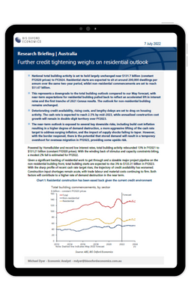
Powered by HomeBuilder and record low interest rates, total building activity rebounded 13% in FY2021 to $131.21 billion (constant FY2020 prices). With the winding back of stimulus and capacity constraints biting, a modest 2% fall is estimated for FY2022.
Given a significant backlog of residential work to get through and a sizeable major project pipeline on the non-residential building front, total building starts are expected to rise 3% to $133.31 billion in FY2023. With the sharp profile of recent cash rate target rises, the trajectory of credit availability has worsened. Construction input shortages remain acute, with trade labour and material costs continuing to firm. Both factors will contribute to a higher rate of demand destruction in the near term.
What you will learn:
-
National total building activity is set to hold largely unchanged near $131.7 billion (constant FY2020 prices) to FY2024. Residential starts are expected to sit at around 200,000 dwellings per annum over the same two-year period, whilst non-residential commencements are set to reach $51.67 billion.
-
This represents a downgrade to the total building outlook compared to our May forecast, with near-term expectations for residential building pulled back to reflect an accelerated lift in interest rates and the first tranche of 2021 Census results. The outlook for non-residential building remains unchanged.
-
Deteriorating credit availability, rising costs, and lengthy delays are set to drag on housing activity. The cash rate is expected to reach 2.5% by mid-2023, while annualised construction cost growth will remain in double-digit territory over FY2023.
Tags:
Related posts

Post
Student housing makes the grade in Australia
Rising student demand and limited housing availability are pushing rents higher and reinforcing investor confidence in Australia’s student accommodation market.
Find Out More
Post
Australia’s Infrastructure Outlook: Big Shifts, Bigger Challenges
Australia’s infrastructure landscape is shifting fast, driven by new investment trends, emerging asset classes and growing capacity constraints. This outlook explores the major changes ahead and what industry and government must do to navigate the decade effectively.
Find Out More
Post
Wage growth stable, but divergence under the hood in Australia
Wage growth held steady in Q3, reinforcing a still-tight labour market. But with conditions set to soften, we expect unemployment to rise and wage pressures to ease through next year.
Find Out More