
Europe’s renovation race to net-zero
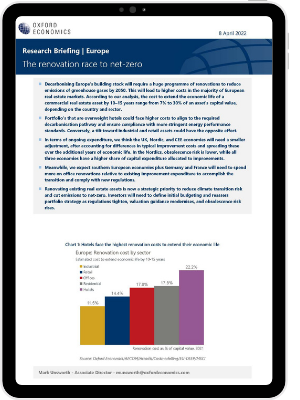
Decarbonising Europe’s building stock will require a huge programme of renovations to reduce emissions of greenhouse gases by 2050. This will lead to higher costs in the majority of European real estate markets. According to our analysis, the cost to extend the economic life of a commercial real estate asset by 10–15 years range from 7% to 30% of an asset’s capital value, depending on the country and sector.
What you will learn:
- Renovating existing real estate assets is now a strategic priority to reduce climate transition risk and cut emissions to net-zero. Investors will need to define initial budgeting and reassess portfolio strategy as regulations tighten, valuation guidance modernises, and obsolescence risk rises.
- Portfolio’s that are overweight hotels could face higher costs to align to the required decarbonisation pathway and ensure compliance with more stringent energy performance standards.
- In terms of ongoing expenditure, we think the UK, Nordic, and CEE economies will need a smaller adjustment, after accounting for differences in typical improvement costs and spreading these over the additional years of economic life.
- We expect southern European economies plus Germany and France will need to spend more on office renovations relative to existing improvement expenditure to accomplish the transition and comply with new regulations.
Related Posts

Post
Real Estate Key Themes 2026: CRE deal recovery delayed, not derailed
Real estate is still poised for a revival in 2026. Although 2025’s deal recovery was delayed, the key fundamentals remain in place for renewed momentum.
Find Out More
Post
Inflation and bond yield shocks in Europe affect RE returns the most
Our modelling shows European real estate is most exposed to inflation and bond-yield shocks, with impacts varying widely across cities and sectors.
Find Out More