
Recent Release | 28 Feb 2022
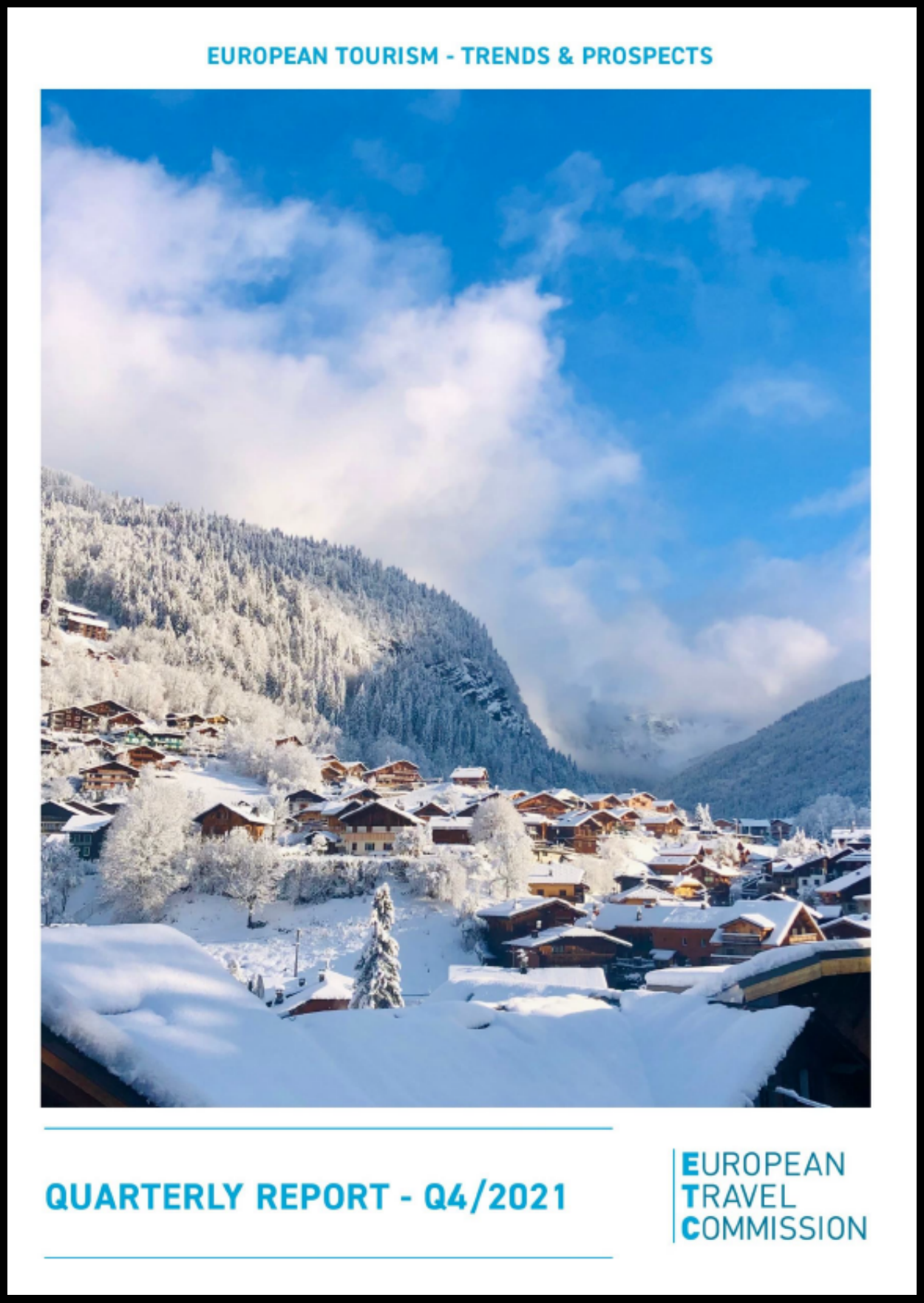
European Tourism 2022: Trends and Prospects (Q4/2021)

Tourism Consulting Team
Tourism Economics

The emergence of the Omicron variant at the year-end, and record-breaking infection rates, brought back mobility restrictions which paused recovery.
2021 data informs estimates of a 62% decrease in tourist arrivals to Europe over 2019 levels, although final data are not yet available. Economic recovery is expected to continue in 2022, but Omicron means growth will be slightly more subdued, at least for the first quarter.
The travel outlook for Europe remains positive, with demand projected to be just 20% below pre-pandemic levels in 2022, fuelled by domestic and intra-European travel demand. Domestic travel is expected to exceed pre-pandemic peaks this year, while rapid intra-regional demand will drive improvement in international.
About the team
Our consulting team at Tourism Economics are the world’s leading analysts of the global tourism and travel sector. They combine their expert insight with our state-of-the-art economic models and tools to answer the crucial questions facing our clients. Lead consultants on the project were:

Dave Goodger
Managing Director, EMEA, Tourism Economics
Dave Goodger
Managing Director, EMEA, Tourism Economics
London, United Kingdom
David Goodger is Managing Director, EMEA, Tourism Economics. He has been instrumental in developing the global model of tourism flows and spending, which covers 185 origins and destinations, and he continues to manage regular forecast updates. He also maintains an active role in new product development and consultancy work.
David Goodger is a Director within Tourism Economics and primarily concentrates on tourism demand forecasting and market sizing. He has also taken an active role in further model development for specific purposes, with an emphasis on examining the economic contributions of particular sectors and the impact of different policies. He has conducted a groundbreaking analysis of the business travel sector for the WTTC and the US Travel Association which estimates the return on investment of corporate spending on travel and he has developed models to define destination marketing allocations.
Since joining Oxford Economics in 2000, David Goodger has been involved in a wide range of forecasting and modelling activities. He has been part of the macroeconomic forecasting and the industrial forecasting teams contributing to both regular reports and specific client studies as well as assisting in the development of detailed forecasting and simulation models.
David was educated at the University of Bristol, England, where he gained a first-class degree in Economics with Statistics; and at the London School of Economics and Political Science, England, where he graduated with an MSc in Econometrics and Mathematical Economics.
Related Services

Post
KPMG M&A Outlook 2026: Between Uncertainty, Resilience, and Seizing Opportunities
Discover how Germany’s M&A landscape is evolving – with a focus on growth, AI and post-merger value creation.
Find Out More
Post
Silver, the next generation metal
This report highlights the critical role silver plays in data centres and artificial intelligence (AI), automotive and electric vehicles (EVs), and solar energy photovoltaics (PVs). With these sectors expected to expand significantly over the coming years, we expect future silver demand to be strong.
Find Out More
Post
Powering the UK Data Boom: The Nuclear Solution to the UK’s Data Centre Energy Crunch
The UK’s data centre sector is expanding rapidly as digitalisation, cloud computing, and artificial intelligence (AI) drive surging demand for high-performance computing infrastructure.
Find Out More