
How GenAI will change the world economy
Generative AI has the potential to substantially improve the medium-term growth outlook for the economy. It arrives at a perfect moment – labour is going to be less supportive of growth as aging dynamics hit home and productivity is flagging.
What you will learn:
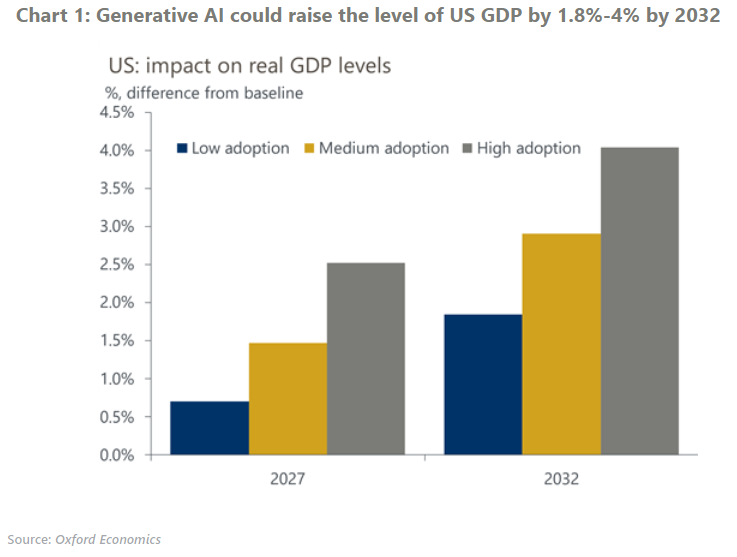
- According to our modelling, the impact of GenAI on medium-term growth will be sizable. Using the US as a case study, we estimate GDP there could rise by between 1.8%-4% by 2032 depending on the speed of adoption. Other less flexible and knowledge-rich countries should also benefit, though to a lower extent.
- Gains from GenAI may be even greater if it not only helps to automate tasks but also leads to increased innovation. At this stage, however, we are sceptical of a permanent increase in productivity growth – we think the more significant productivity gains will come from the automation of a wide array of tasks.
- Although the economy wide-gains will arrive eventually, they won’t be immediate. We think the impact of GenAI is likely to be a disinflationary force for the global economy in the medium term, as higher productivity is unlikely to be matched immediately by higher wage growth. In contrast, AI-related investment may raise demand, adding to cost pressures.
Tags:
Related Services

Post
Are humanoid robots creepy?
Some very smart people are betting that machines shaped like humans will do much of our household and factory work for us in the near-ish future. But hurdles remain.
Find Out More
Post
Powering Low-Income Countries’ AI Opportunity
Low-income countries could unlock $75T in annual gains through AI, energy access, and finance narrowing global living standard gaps and driving growth.
Find Out More
Post
AI: The next generation of automation
explore how automation and AI are transforming operations across manufacturing, retail, and logistics. From empowering frontline workers to driving measurable efficiency gains, organizations are using intelligent operations to boost productivity, customer satisfaction, and competitiveness in a fast-changing global economy.
Find Out More