
Easing financial conditions offer CRE some respite
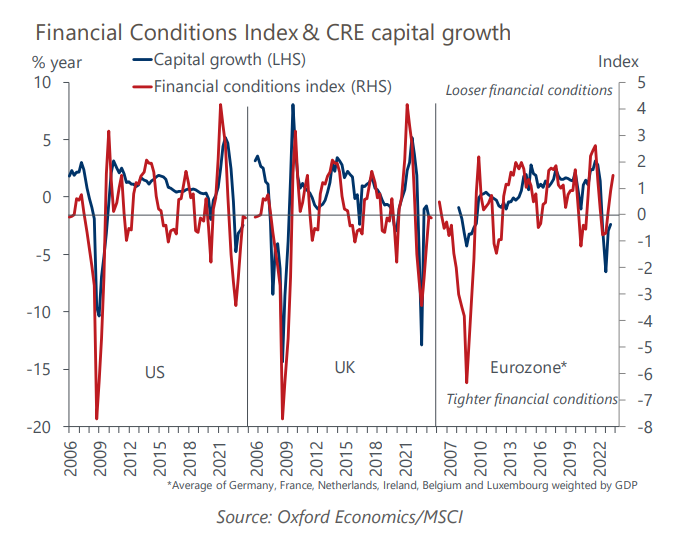
Our measure of financial conditions has become less restrictive in the US and started to loosen in the eurozone and the UK, reflecting investors’ expectations that interest rates have peaked. This should aid the outlook for commercial real estate (CRE) on the margins, although the scale of past rate hikes, sluggish economies, and structural headwinds mean the sector still confronts challenging fundamentals.
What you will learn:
- The evidence suggests that movements in financial conditions are an important driver of CRE prices, reflecting the sector’s use of bank lending and, indirectly, the influence of financial conditions on economic activity and demand for commercial property.
- The next move in interest rates by the Fed, the European Central Bank, and the Bank of England will likely be down, a particular positive for CRE given the importance of floating-rate debt and the scale of refinancing needs over the next few years. Among major economies, our measure of financial conditions has loosened the most in the eurozone, suggesting CRE upside for the bloc.
- However, CRE is confronted with pressures unrelated to financial variables, such as higher labour and material costs and, in the office sector, structurally lower occupancy rates. Hence, recent favourable moves in financial conditions will go only so far in supporting the asset class.
Tags:
Related Services

Post
Real Estate Key Themes 2026: CRE deal recovery delayed, not derailed
Real estate is still poised for a revival in 2026. Although 2025’s deal recovery was delayed, the key fundamentals remain in place for renewed momentum.
Find Out More
Post
Inflation and bond yield shocks in Europe affect RE returns the most
Our modelling shows European real estate is most exposed to inflation and bond-yield shocks, with impacts varying widely across cities and sectors.
Find Out More
Post
2026 US real estate supply outlook
Explore how shifting supply trends are shaping industrial, office, retail and residential real estate in 42 US metros. Download our infographic today.
Find Out More