
Weakened confidence forces building activity downwards in China
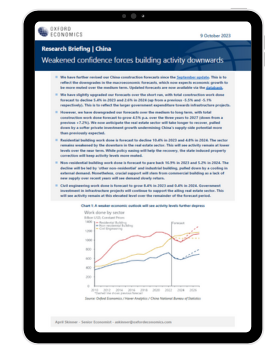
We have slightly upgraded our forecasts over the short run, with total construction work done forecast to decline 5.4% in 2023 and 2.6% in 2024 (up from a previous -5.5% and -5.1% respectively). However, we have downgraded our forecasts over the medium to long term, with total construction work done forecast to grow 4.5% p.a. over the three years to 2027 (down from a previous +7.2%).
What you will learn:
- Residential building work done is forecast to decline 10.4% in 2023 and 4.8% in 2024. The sector remains weakened by the downturn in the real estate sector. This will see activity remain at lower levels over the near term. While policy easing will help the recovery, the state induced property correction will keep activity levels more muted.
- Non-residential building work done is forecast to pare back 16.9% in 2023 and 5.2% in 2024. The decline will be led by ‘other non-residential’ and industrial building, pulled down by a cooling in external demand. Nonetheless, crucial support will stem from commercial building as a lack of new supply over recent years will see demand slowly return.
- Civil engineering work done is forecast to grow 8.4% in 2023 and 0.4% in 2024. Government investment in infrastructure projects will continue to support the ailing real estate sector.
Tags:
Related Posts

Post
Half-Built Britain: Unlocking the Nation’s Infrastructure Growth Plans
Half-built Britain - unlocking the nation’s infrastructure growth plans has been written for the Construction Plant-hire Association. It investigates how the government's plans translate into action on the ground through the lens of three major policy releases over the summer of 2025—the Comprehensive Spending Review, Industrial Strategy, and National Infrastructure Strategy.
Find Out More
Post
Booms, busts and bulk water – a familiar infrastructure challenge is unfolding now
Australia last experienced a boom in water-related infrastructure construction in the 2000s and early 2010s, following two decades of underinvestment in the 1980s and 1990s.
Find Out More
Post
Water under pressure: expanding capacity amid rising risk in Australia
Australia’s population is expected to continue steadily increasing, particularly in key cities like Sydney, Melbourne, Perth and Brisbane.
Find Out More