
China: Saying yes to more monetary easing
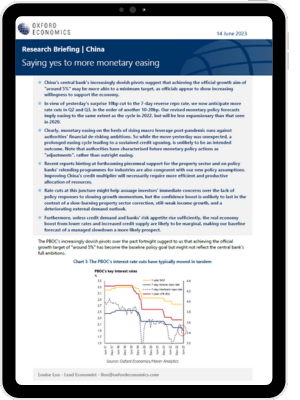
China’s central bank’s increasingly dovish pivots suggest that achieving the official growth aim of “around 5%” may be more akin to a minimum target, as officials appear to show increasing willingness to support the economy.
In view of the surprise PBOC cut to the 7-day reverse repo rate, we now anticipate more rate cuts in Q2 and Q3. This will bring total monetary easing to the same extent as the cycle in 2022, but less expansionary than that seen in 2020. A prolonged easing cycle leading to a sustained credit upswing is unlikely to be PBOC’s intended outcome.
What you will learn:
- Recent reports hinting at forthcoming piecemeal support for the property sector and on policy banks’ relending programmes for industries are also congruent with our new policy assumptions. Improving China’s credit multiplier will necessarily require more efficient and productive allocation of resources.
- Rate cuts at this juncture might help assuage investors’ immediate concerns over the lack of policy responses to slowing growth momentum, but the confidence boost is unlikely to last in the context of a slow-burning property sector correction, still-weak income growth, and a deteriorating external demand outlook.
- Furthermore, unless credit demand and banks’ risk appetite rise sufficiently, the real economy boost from lower rates and increased credit supply are likely to be marginal, making our baseline forecast of a managed slowdown a more likely prospect.
Tags:
Related posts

Post
A reality check on the status of RMB internationalisation
The recent geopolitical shocks and abrupt US policy shifts have heightened concerns about the stability of the dollar-centric global financial system and strengthened the perceived need for diversification.
Find Out More
Post
China and AI underpin stronger global trade outlook
Global trade is set for a stronger-than-expected rebound, supported by lower US tariffs, continued AI-driven investment, and China’s renewed export push. Our latest forecasts show upgrades to both nominal and volume trade growth in 2025–26, even as legal uncertainty surrounding US tariff mechanisms and evolving geopolitical dynamics pose risks to the outlook.
Find Out More
Post
China’s Outbound Recovery: Slowing but Still Rising
Research Briefing China: Saying yes to more monetary easing The rebound continues, but slowing demand, economic headwinds, and shifting traveler preferences are reshaping the outlook.
Find Out More