
US | Metro Economic Forecast: San Francisco
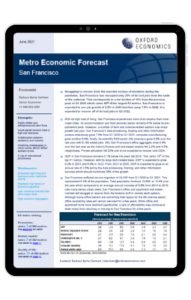
Struggling to recover from the reported exodus of residents during the pandemic, San Francisco has recouped only 28% of its lost jobs from the nadir of the outbreak. This corresponds to a net decline of 10% from the previous peak of Q1 2020 which ranks 46th of the largest 51 metros. San Francisco is expected to see job growth of 2.5% in 2021 but then jump 7.5% in 2022. It is expected to recover all of its lost jobs in Q3 2022.
What you will learn:
- San Francisco’s data processing, hosting and other information sectors collectively grew 7.5% from Q1 2020 to Q1 2021; computer manufacturing grew another 5.0%; finally, its scientific R&D sector (life sciences) grew 9.0% over the last year with 5,100 added jobs. Still, San Francisco’s office aggregate shed 3.0% over the last year as the metro’s finance and real estate sectors fell 2.3% and 4.5%, respectively.
- GDP in San Francisco remains 0.1% below the peak Q4 2019. This ranks 19th of the top 51 metros. However, with its large tech-related base, GDP is expected to grow 9.2% in 2021 and 5.9% in 2022.
- San Francisco suffered net out-migration of 24,300 from Q1 2020 to Q1 2021. This represented 0.5% of the population. Total population declined 19,600, or -0.4% over the year which compares to an average annual increase of 0.6% from 2014 to 2019.
Tags:
Related Services

Post
APAC Key Themes 2026: Paybacks, policy offsets and trade
We believe APAC will remain the strongest global performer in 2026. However, the growth trajectory will likely be more uneven than in past cycles.
Find Out More
Post
Japan’s fiscal policy will remain loose, which increases risks to debt sustainabilit
We've changed our fiscal outlook for Japan in our December forecast round. We now expect the new government to set a primary deficit close to that of 2024, at 2%-3% of GDP for 2025-2027, instead of restoring a balanced budget by taking advantage of strong tax revenue. We assume higher bond yields will force the government to take measures to reduce the deficit from 2028.
Find Out More