
Easing supply hurdles won’t offset falling industrial demand in APAC
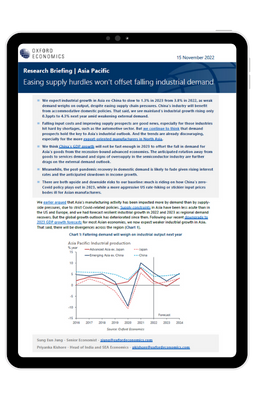
We earlier argued that Asia’s manufacturing activity has been impacted more by demand than by supply-side pressures, due to strict Covid-related policies. Supply constraints in Asia have been less acute than in the US and Europe, and we had forecast resilient industrial growth in 2022 and 2023 as regional demand recovers. But the global growth outlook has deteriorated since then. Following our recent downgrade to 2023 GDP growth forecasts for most Asian economies, we now expect weaker industrial growth in Asia. That said, there will be divergences across the region.
What you will learn:
- We expect industrial growth in Asia ex-China to slow to 1.3% in 2023 from 3.8% in 2022, as weak demand weighs on output, despite easing supply chain pressures.
- Falling input costs and improving supply prospects are good news, especially for those industries hit hard by shortages, such as the automotive sector. But we continue to think that demand prospects hold the key to Asia’s industrial outlook. And the trends are already discouraging, especially for the more export-oriented manufacturers in North Asia.
- We think China’s GDP growth will not be fast enough in 2023 to offset the fall in demand for Asia’s goods from the recession-bound advanced economies. The anticipated rotation away from goods to services demand and signs of oversupply in the semiconductor industry are further drags on the external demand outlook.
Tags:
Related Resouces

Post
The rise of Southern India’s business service hubs
Over the next five years, India is set to be one of the fastest-growing major economies across Asia Pacific, lead by the performance of its IT and business services. The Southern states of Karnataka and Telangana are at the forefront of this success as they are home to two of India’s most rapidly growing cities and productive cities—Bengaluru and Hyderabad.
Find Out More
Post
Tech-enabled productivity may mean a job-lite expansion in Asia Pacific
The US is undergoing or heading towards a 'jobless expansion'. Asian economies, likewise, will probably experience slow job growth over the next few years, accompanied by mechanically rising productivity gains. In the near term, the drag on the job market is likely to come from cyclically weak demand for labour. But further down the line, it is the shrinking labour supply that will weigh more heavily on employment growth.
Find Out More
Post
China’s export transition reorders regional supply chains
China’s emerging roles as both a critical intermediate goods supplier to global supply chains and a dominant producer of high value-added goods will remain the key forces sustaining its large current account surplus, far more so than the eventual direction of US tariffs.
Find Out More