
Major cities will see GDP growth rates diverge, 2022-26
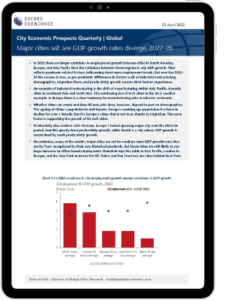 In 2022 there are larger variations in employment growth between cities in North America, Europe, and Asia Pacific than the variations between those regions in city GDP growth. That reflects pandemic-related factors, influencing short-term employment trends. But over the 2022-26 the reverse is true, as pre-pandemic differences in factors such as industrial restructuring, demographics, migration flows, and productivity growth resume their former importance.
What you will learn:
- An example of industrial restructuring is the shift of manufacturing within Asia Pacific, towards cities in southeast Asia and south Asia. The continuing rise of tech cities in the US is another example.
- Whether cities can create and then fill new jobs depends in part on demographics. Europe’s working age population has been in decline for over a decade. But for Europe’s cities, that is not true, thanks to migration.
- Productivity also matters a lot. Warsaw, Europe’s fastest growing major city over the 2022-26 period, benefits greatly from productivity growth.
Related Posts

Post
Trends are reinforcing the strength of major cities
Leading cities like London, New York, and San Jose are thriving through technology, knowledge industries, and demographic advantages. As global shifts and AI reshape urban economies, which cities will stay ahead in the coming years?
Find Out More
Post
The most competitive cities in the GCC in 2025
Our latest Global Cities Index 2025 analysis of 1,000 cities around the world allows us to put major GCC cities in the context of global peers, revealing the dynamics behind their economic vitality, human capital, quality of life, and long-term sustainability.
Find Out More